

Kids alarm clock guide: ok-to-wake lights, first alarms and P1 stationery
In this article
- How to teach your child to use a wake-up clock, step by step
- Which kids alarm clock fits which age
- Button batteries and charging: what to check
- Night lights and screens in the bedroom
- What a Primary 1 child needs in the pencil case
- What kids alarm clocks and stationery cost
- When to get help
- Frequently asked questions
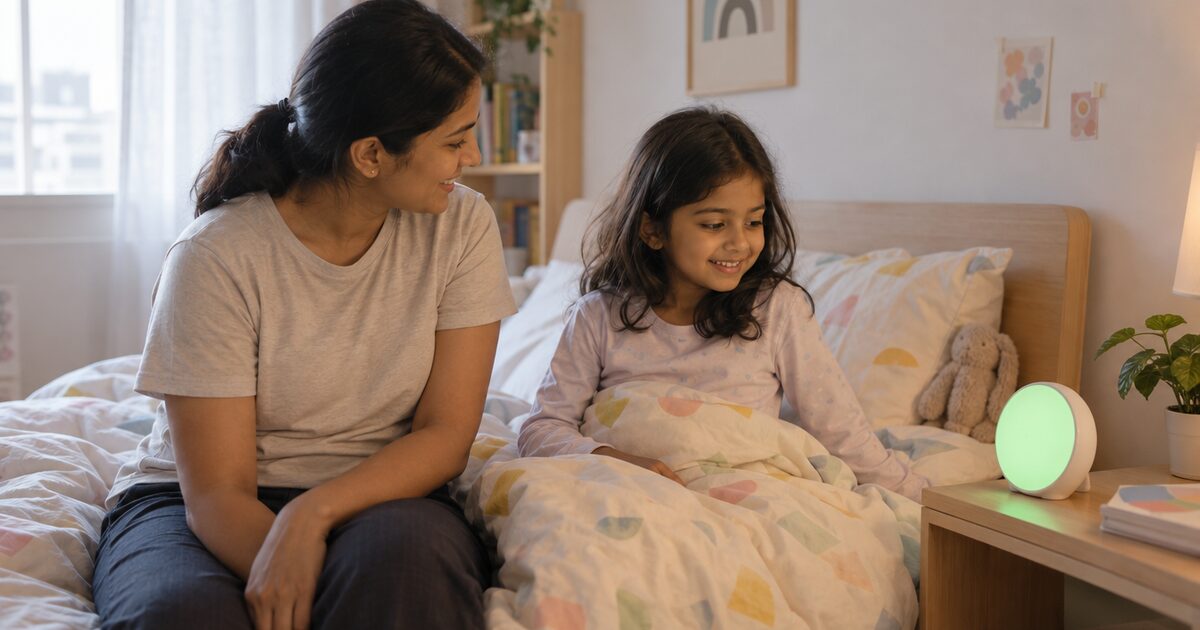
A kids alarm clock does two different jobs as your child grows. For a preschooler, an ok-to-wake light shows when it's time to get out of bed, with no numbers to read. For a Primary 1 child, a plain alarm helps them get themselves up for school. Whichever you buy, check the battery cover first: CPSO says button batteries can be fatal if swallowed by young children.
How to teach your child to use a wake-up clock, step by step
- Work out how much sleep your child needs. KKH's 24-hour activity guidelines give 10 to 13 hours a day for 3 to 5 year olds and 9 to 11 hours for 6 year olds. The kids bedtime calculator turns that into a bedtime.
- Set one wake-up time and keep it on school days and holidays alike. KKH advises a consistent bedtime and waking time, and HealthHub suggests the same calming routine before every bedtime.
- Switch the clock from its sleep light to its wake light once while your child lies in bed, so they know what to watch for.
- Put the clock where your child can see it from bed but can't reach it. CPSO says devices with button batteries should be kept out of reach of young children.
- Turn the light down to its dimmest setting. KKH says a young child's room should be cool, quiet and dark, without a TV.
- Keep the same short routine before lights out, such as a story. KKH calls story time a good pre-bed ritual, and HealthHub says to keep screens out of the bedroom and off for at least an hour before bed.
- Reassure your child briefly if they call out before the wake light comes on. KKH says that if you go into the room, don't stimulate your child or stay too long.
- Praise your child each time they wait for the light.
- Switch to a plain alarm clock when your child starts Primary 1. MOE suggests teaching them to pack their school bag the day before and put on their uniform and shoes, then letting them do it with minimal help.
Which kids alarm clock fits which age
Match the clock to what your child can read. The sleep hours below come from KKH.
| Age | Clock type | What to check |
|---|---|---|
| 1 to under 3 | A routine first. A clock is optional | 11 to 14 hours of sleep a day. Any clock out of reach, battery cover shut |
| 3 to 5 | Ok-to-wake light clock | 10 to 13 hours a day. Dimmest setting, two colours easy to tell apart |
| 6 | Ok-to-wake light, or a simple alarm if they read numbers | 9 to 11 hours a day. One wake time for every day |
| School age, from P1 | Plain alarm clock with numbers | 9 to 11 hours a night. Loud enough, one easy off button, no screen |
For naps, night waking and bedtime battles, the toddler sleep guide covers the rest.
Button batteries and charging: what to check
Many kids clocks run on a coin cell or charge by USB. Challenger's listing for a kids alarm clock says it comes with one CR2032 coin battery and a USB-C power cable. CPSO says these button batteries sit in many household devices, such as remote controls, toys and torches, and a young child may swallow one or push it into an ear or nose.
- Check that the battery cover is secured and can't be opened easily by a young child (CPSO).
- Check old batteries for leaks and take a leaking one out of use straight away (CPSO). CPSO says batteries never go in general bins or blue recycling bins, so drop them at an e-waste recycling point.
- For a clock that charges, check the adaptor has a valid SAFETY Mark, unplug it when full, and never charge it under a pillow or on the bed (CPSO's lithium-ion battery tips).
- Stop using a clock whose battery looks bloated, leaks or feels very hot while charging, and contact the authorised distributor (CPSO).
- Look up the clock on CPSO's safety alerts and recalls page before you buy. It has a separate list for electrical products.
CPSO, citing the Australian Competition and Consumer Commission, says a swallowed button battery can burn through the food pipe in as little as two hours. If you think your child has swallowed one, get emergency medical help immediately. Battery toys follow the same rules; see toy safety in Singapore.
Night lights and screens in the bedroom
A dim light helps a child who feels uneasy sleeping alone. HealthHub's Grow Well SG page suggests a night light in the room or leaving the door slightly open. Keep it low, since KKH says a young child's room should be dark, and HealthHub suggests blackout curtains when bright light keeps a child awake. Some clocks double as a night light: Toys"R"Us lists a character clock where you tap the head to snooze and switch the light on.
Use a clock as your child's alarm and keep the phone out. HealthHub says to keep screens out of the bedroom, and KKH says to keep TV and computers out of a school-age child's room. MOH's guidance, shown on the same HealthHub page, says not to give a child a mobile device with unrestricted internet, and to keep screens under 2 hours a day for 7 to 12 year olds outside schoolwork. More in managing screen time for kids.
What a Primary 1 child needs in the pencil case
Each primary school issues its own booklist, so buy from your school's list. As one example, Xinmin Primary's 2024 P1 orientation guide asks children to bring these every day:
- 2 or 3 sharpened 2B pencils, not mechanical ones
- A soft eraser, a short plastic ruler and a sharpener
- An erasable green pen for corrections, and a glue stick
- A box of coloured pencils, preferably 12 colours
- A homework file, the Student Handbook and a storybook for silent reading
The same guide asks parents to label stationery and other belongings with the child's name and class. It cites a ministry guideline that a school bag should weigh no more than 15% of your child's body weight, and asks parents to avoid heavy bags and water bottles. A small zip case that holds the daily items keeps the load down.
If writing looks like hard work, watch the grip. NUH's Child Development Unit lists a poor or awkward pencil grip, tired hands and slow, effortful writing among the signs of handwriting difficulty, and says some are common when preschoolers first start to write. Ask an occupational therapist if you're unsure. NUH also suggests play dough and different drawing materials from as young as 18 months; teaching your child to write has more.
MOE suggests setting aside a space at home for writing and drawing. For the rest of the lead-up, see getting your child ready for Primary 1 and the P1 preparation checklist.
What kids alarm clocks and stationery cost
On the product pages of four sellers we read on 7 Nov 2026, a kids alarm clock or small bedside alarm clock had a listed price of $1.90 to $29.98. We found no ok-to-wake light clock listed on the seller sites we searched that day, so none is priced here. Two of the listings below sell batteries separately. Prices sellers publish, in alphabetical order:
| Seller | What the listing is | Listed price, 7 Nov 2026 |
|---|---|---|
| Challenger | Kids alarm clock, USB-C powered, CR2032 coin battery included | $19.90 |
| IKEA | Small alarm clock, 7 x 6 cm, 1 AAA battery sold separately | $1.90 |
| Popular | Digital alarm clock, USB-C rechargeable, weekday and weekend alarms | $29.90 |
| Popular | Box of 12 2B pencils | $2.90 |
| Popular | Nylon pencil case, 200 x 100 mm | $3.95 |
| Toys"R"Us | Character alarm clock with night light, 3 AA batteries not included | $29.98 |
When to get help
- You think your child has swallowed a button battery: get emergency medical help immediately (CPSO). Go to KKH's Children's Emergency (Basement 1, Children's Tower) or NUH's 24-hour Children's Emergency (NUH Main Building, Zone F, Level 1).
- Your child is choking, has stopped breathing or doesn't respond to you: dial 995, as HealthHub advises.
- Your child snores loudly, breathes noisily, has trouble falling or staying asleep with daytime sleepiness, or wakes with headaches: see a doctor, as KKH advises for each of these.
- Writing stays slow and tiring, or the grip looks awkward and you're unsure: ask an occupational therapist (NUH).
- Your child is worried or stressed about school: talk to the School Counsellor (HealthHub).
- A clock's battery swells, leaks or gets very hot: stop using it and contact the authorised distributor. To report an unsafe product, call CPSO on 1800 325 8282 or use its contact page.
Frequently asked questions
What is an ok to wake clock?
It's a clock that changes its light or picture at the wake-up time you set, so a child who can't read numbers knows when to get up. Keep the wake time the same every day, as KKH advises, and keep the clock dim and out of reach.
When should I get a toddler sleep clock?
The KKH and HealthHub pages we read give no set age for one. For toddlers, KKH stresses 11 to 14 hours of sleep a day with regular sleep and wake times, which a steady routine gives you. If you buy one for a child under 3, place it out of reach and check the battery cover is secured.
What should a first alarm clock for kids have?
Clear numbers, a sound loud enough to wake your child, and one off button they can find without help. A clock with no screen or internet lets the phone stay out of the bedroom, as HealthHub advises. Check its battery cover and charger too.
What's on a primary 1 stationery list?
Each school sets its own booklist, so check yours first. Xinmin Primary's 2024 guide, as one example, asks for 2B pencils, an eraser, a ruler, a sharpener, a green pen for corrections, glue, coloured pencils and a homework file. Label each item with your child's name and class.
Where can I buy kids stationery in Singapore?
Bookshops and stationery shops carry the basics, and your school's P1 guide may name its school bookshop for booklist items, as Xinmin Primary's does. On 7 Nov 2026, Popular listed a box of 12 2B pencils at $2.90. CPSO oversees stationery as a general consumer good, which must meet applicable safety standards.
Can my child use a phone as an alarm clock?
A plain clock is simpler. HealthHub's Grow Well SG page says to keep screens out of the bedroom and off for at least an hour before bed. MOH's guidance on the same page says not to give a child a mobile device with unrestricted access to the internet and apps.
- KKH, Singapore Integrated 24-Hour Activity Guidelines for children under seven years launched (read 7 Nov 2026)
- KKH, Sleep: growing up (read 7 Nov 2026)
- CPSO (CCS), Safety tips on button batteries (read 7 Nov 2026)
- CPSO (CCS), Safety tips for consumer devices powered by lithium-ion batteries (read 7 Nov 2026)
- HealthHub (HPB), Grow Well SG: Nurturing healthy behaviours, with MOH's Guidance on Screen Use in Children (read 7 Nov 2026)
- MOE, How can I support my child to transition smoothly to Primary 1? (read 7 Nov 2026)
- NUH Child Development Unit, Handwriting difficulty handout (read 7 Nov 2026)
- Xinmin Primary School, P1 School Orientation Guide 2024 (read 7 Nov 2026)
- Challenger, Valore Kids Alarm Clock (HA-004) product page (read 7 Nov 2026)
- IKEA Singapore, KUPONG alarm clock product page (read 7 Nov 2026)
- Popular, Milk Box Digital Alarm Clock (USB-C rechargeable) product page (read 7 Nov 2026)
- Popular, POP Bazic 2B pencil 12s product page (read 7 Nov 2026)
- Popular, Helix nylon pencil case 200 x 100 mm product page (read 7 Nov 2026)
- Toys"R"Us Singapore, Paladone Care Bears Cheer Bear icon alarm clock product page (read 7 Nov 2026)

Air purifier for baby: when it helps and what to check
Do babies need an air purifier? What NEA and HealthHub say on HEPA, CADR for an HDB bedroom and ozone, plus seller price...
6 min read
Art Jamming in Singapore: A Family Guide to Painting and Art Fun
Your parent's guide to art jamming in Singapore: what it is, the best ages, studio vs cafe vs at-home, what to bring, ro...
11 min read
Baby Fairs in Singapore: A Parent's Guide to Deals, Dates and Smart Shopping
A practical guide to baby fairs in Singapore: where they run, what to buy and skip, how to spot real deals, what to brin...
10 min read