

How to prepare your child for Primary 1: a plan from K2 to week two
In this article
To prepare your child for Primary 1, spend K2 on independence, feelings and routines, and keep schoolwork light. MOE says most children start P1 able to recognise some letters, write their name and count from 1 to 10. P1 teachers support children who aren't there yet, and there are no weighted assessments or exams in P1 and P2.
For the admin side, like forms and Edusave, use the Primary 1 preparation checklist. This guide is about getting your child ready once they have a place. Still registering? MOE's 2026 exercise covered children born 2 January 2020 to 1 January 2021, and the P1 registration guide has the phases.
How to prepare your child for Primary 1, step by step
- Talk with your child about P1 early in K2, and ask how they feel about it and what worries them. MOE's transition advice starts with these conversations.
- Visit the school's open house together, as MOE suggests, or look through the school's website and photos with your child if you can't go.
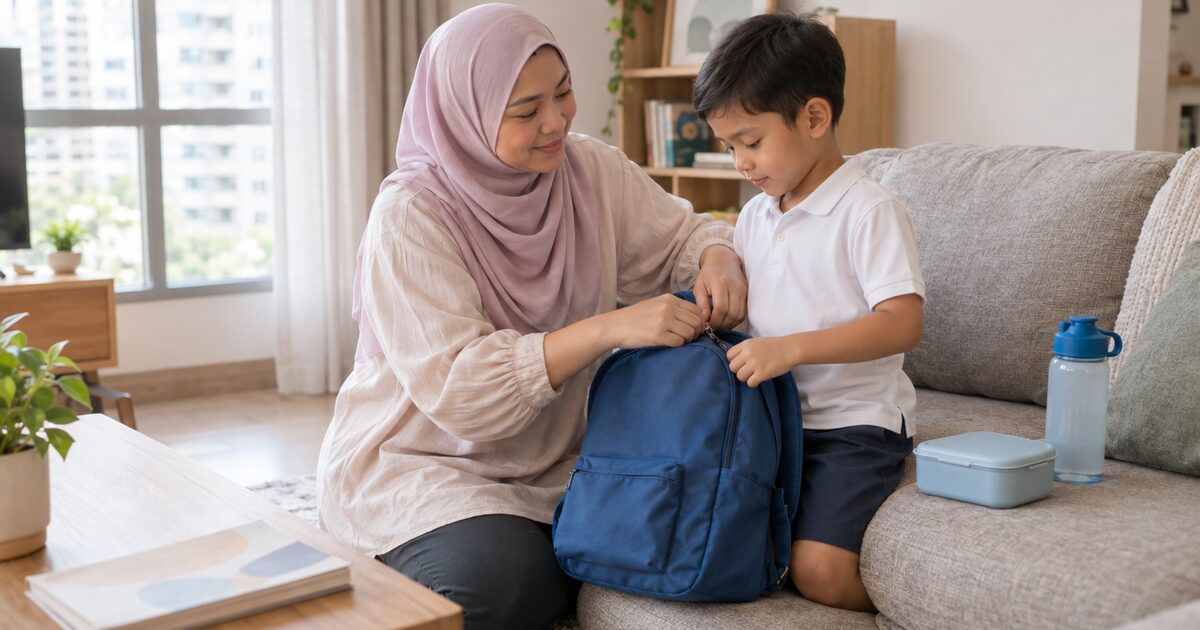
- Let your child pack their own bag and put on their uniform and shoes with little help, which is one of the habits MOE asks parents to build.
- Practise buying food at a hawker stall or shop, since MOE suggests role-playing recess scenarios like this one before P1 starts.
- Practise letters and numbers only up to MOE's start-of-P1 list in the table below, because MOE calls heavy academic prep a common pitfall.
- Go to the school orientation with your child, where MOE says you can ask about student care and the school bus, fill in forms and buy uniforms and textbooks.
- Move bedtime earlier in the weeks before term: KKH says six-year-olds need 9 to 11 hours of sleep a day, and the bedtime calculator works back from wake-up time.
- Put the first day in your calendar, because MOE's 2027 calendar starts P1 on Monday, 4 January 2027, a day before P2 to P6.
- Check in with your child through weeks one and two about recess, friends and the teacher, and tell the form teacher if the same worry keeps coming back.
What MOE says P1 expects, and what to practise
MOE's EdTalks article on starting P1, published on 14 November 2025, lists the basics most children manage at the start of P1. It also names the social skills to build. Compare the list with what you see at home, then practise through play.
| Area | What MOE says to aim for by the start of P1 | What to practise at home |
|---|---|---|
| English | Recognise some letters and common words such as "I", "at" and "is", write their name, copy words and short sentences | Read together, spot letters on signs, write their name on drawings and cards |
| Mother Tongue | Use familiar greeting phrases and follow one- or two-step instructions | Greet family in Mother Tongue and give simple two-step requests in it |
| Maths | Say 1 to 10 in order, know those numbers as numerals and words, compare two groups within 10 | Count snacks, stairs or coins, and ask which plate has more |
| Feelings and friends | Name and manage feelings, take turns, show care, ask a trusted adult for help | Name feelings out loud, play turn-taking games, practise asking a teacher for help |
MOE says over-preparing is a common pitfall. Children who have already learnt the material can get bored in class and lose their joy of learning. Preschools teach these basics, P1 teachers are trained to support children at different levels, and support programmes pick up children who need more.
For play ideas, the reading guide and the writing guide go skill by skill. Numbers have their own guide, maths skills by age. MOE also suggests library visits and the storytelling sessions held there. Weighing up P1 prep classes? Is tuition necessary? walks through it.
Self-help skills for recess and the school day
MOE notes that P1 brings longer school hours and a more structured day than preschool. Most of what helps is practice at home, a little at a time:
- Let your child choose and pay for food at a hawker stall or shop, then check the change with you.
- Give them coins in a small purse and keep it in the same pocket of the bag every day.
- Practise opening the water bottle, food box and snack packets they'll take to school.
- Practise using the toilet alone, washing hands, and asking a teacher before leaving the class.
- Show them how to pack the bag from the timetable. MOE says P1 brings new subjects and a different timetable, so pack for each day's lessons.
- Walk the route together, or practise the handover if a helper, grandparent or school bus does the school run. The school bus fee calculator estimates the cost.
Until the school smart card arrives, MOE says your child can keep using their child EZ-Link card. The school takes the photo after term starts, and the card comes by the end of April.
Feelings, friends and the first weeks
MOE's tips start with social and emotional skills. It asks parents to help children name, express and manage their feelings, think before acting, and see that actions have consequences. Give feelings plain words like scared, angry or anxious. Share how you felt on a bad day, so your child knows adults have big feelings too.
For friendships, MOE lists taking turns, showing care and respect, saying what they think, and knowing when to ask a trusted adult for help. MOE also asks you to tell your child that teachers will help, and to encourage questions to the form teacher or school counsellor.
Some children cry at the gate in the first week. Keep the goodbye short and the same each day. The starting childcare guide has goodbye routines that carry over to P1.
After school, ask open questions. Who did you sit with? What did you buy at recess? MOE asks parents to talk with teachers too, so home and school expect the same things, and to ask how your child is coping.
Sleep, screens and after-school care
KKH's 24-hour activity guidelines say children aged 3 to 5 need 10 to 13 hours of sleep a day, and six-year-olds need 9 to 11. Older preschoolers may not need a nap if they already get enough sleep. KKH suggests a wind-down routine, no screens in the hour before sleep, and the same bedtime on weekdays and weekends.
For screens, MOE points to MOH's guidance: under one hour a day of educational content for children from 18 months to six years. The screen time guide has a fuller plan.
If no one is home after school, ask about the school-based student care centre at orientation. The student care guide covers fees and subsidies. Homework habits come later, and how to motivate your child to study has ideas for when they start.
When to get help
- Your child keeps coming home unhappy or left out: talk to the form teacher. MOE encourages children to take questions to their form teachers or school counsellors.
- Reading isn't clicking: MOE's Learning Support Programme picks up pupils who need help with English at the start of P1, for half an hour a day in groups of 8 to 10.
- Numbers aren't clicking: MOE's Learning Support for Mathematics also starts at P1, with 4 to 8 periods a week in groups of up to 8.
- Settling in or behaviour is hard: ask the school about its SEN Officers, who give in-class and small-group support, and about TRANSIT, MOE's programme for P1 pupils with social and behavioural difficulties.
- You suspect a developmental delay: MSF says to see a polyclinic or CHAS GP for an assessment. They can refer your child to KKH's Department of Child Development or NUH's Child Development Unit. For reading worries, see dyslexia signs in preschool.
- Your child wants someone to talk to: Tinkle Friend (1800-2744-788) is a helpline for primary school children aged 13 and below, open Monday to Friday from 2.30pm to 5pm, and outside those hours it points callers to National Mindline at 1771.
Frequently asked questions
What does my child need to know before Primary 1?
It is a short list. MOE says most children start P1 recognising some letters and common words, writing their name and counting from 1 to 10, with a few Mother Tongue greetings. MOE also asks parents to build feelings, turn-taking and asking for help. Teachers give extra support where it's needed.
When is the first day of Primary 1 in 2027?
MOE's 2027 calendar starts P1 on Monday, 4 January 2027, and P2 to P6 on Tuesday, 5 January. Term 1 runs to Friday, 12 March, and the March holidays run from 13 to 21 March 2027. Check the school's notices for the time to arrive.
What happens at Primary 1 orientation?
MOE says the orientation has familiarisation activities for children and parents. You can ask about the school-based student care centre and the school bus, fill in the school's forms, and buy uniforms and textbooks. If you can't go, MOE says to contact the school to arrange another way.
Does my child need P1 preparation classes in Singapore?
MOE calls over-preparing a common pitfall, and names assessment books, academic enrichment and tuition. Children who already know the material can get bored in class. Preschools cover the basics, P1 teachers adjust to different levels, and support programmes pick up children who need more.
How do I check my child's Primary 1 readiness?
Watch the everyday jobs as well as the schoolwork. Can your child pack a bag and use the toilet alone? Can they say how they feel and ask an adult for help? Then check MOE's list in the table above. If something seems well behind, talk to the preschool teacher first, and see a polyclinic or GP about a development worry.
Are there exams in Primary 1?
No. MOE says there are no weighted assessments or exams in P1 and P2, so children have time to settle into formal school. MOE suggests you ask the form teacher how your child is coping and ask to be kept informed of their progress.
- MOE, How can I support my child to transition smoothly to Primary 1? (read 6 Nov 2026)
- MOE, Transition from preschool to primary school (read 6 Nov 2026)
- MOE, Report to school (read 6 Nov 2026)
- MOE, School terms and holidays for 2027 (read 6 Nov 2026)
- MOE, Learning support (read 6 Nov 2026)
- MOE, Special educational needs support at mainstream primary schools (read 6 Nov 2026)
- KKH, Singapore Integrated 24-Hour Activity Guidelines for Early Childhood, summary (read 6 Nov 2026)
- MSF, Where can I go to get help if I suspect my child has developmental needs? (read 6 Nov 2026)
Art classes for kids in Singapore: what to choose at each age
Art classes for kids in Singapore, age by age: what school art covers, free gallery options, what to watch in a trial, a...
7 min read
Best preschools in Singapore: how to choose a preschool by fees, hours, quality and curriculum
How to choose the best preschool in Singapore: ECDA fees for 1,795 preschools by operator type, hours and SPARK status, ...
14 min read
Bullying in preschool: the warning signs, what to say to your child, and how to escalate with a Singapore childcare centre
Bullying in preschool: how to tell it from rough play, the warning signs, what to say to your child, and the steps to es...
6 min read