

Preschool with outdoor play in Singapore: what ECDA requires and what to ask
In this article
- How to find a preschool with outdoor play, step by step
- What ECDA's Code requires of every preschool
- What the curriculum frameworks say about outdoor play
- How much outdoor time your child needs, and who covers it
- Heat, rain and haze: what the Code says
- Questions to ask on a visit
- When to get help
- Frequently asked questions
Every preschool in Singapore with an ECDA licence has to take your child outside. ECDA's Code of Practice says a child in a full-day programme gets at least an hour of gross motor play a day, like running, climbing and ball games, and at least 30 minutes of it outdoors daily, or 45 minutes three times a week. A preschool with outdoor play is one that goes past that floor and can tell you how. Ask where the children go, for how long, and what happens on hot, wet or hazy days.
How to find a preschool with outdoor play, step by step
- Shortlist centres near home or work on our preschool directory, which lists fees by centre, or on ECDA's LifeSG preschool search. Neither one rates outdoor play, so you'll check that yourself.
- Ask each centre for its weekly timetable. Look for a fixed outdoor slot with a length in minutes.
- Compare it with ECDA's floor. A full-day child must get 30 minutes outdoors daily, or 45 minutes three times a week. A half-day child needs at least one half-hour outdoor session a week.
- Visit during the class's outdoor time. ECDA tells centres to keep children out of direct sun between 11am and 4pm where they can, so ask when that slot is.
- Walk the outdoor space. Look for shade, drinking water and room to run, and count the adults: ECDA requires at least 2 with every group.
- Ask where else the class goes, such as a neighbourhood park or community garden. If children cross a road to get there, ECDA's Code says the centre must tell you how it keeps them safe.
- Ask what happens on wet, hot and hazy days, and whether missed outdoor time is made up later in the week.
- Check the kit list: a hat, a water bottle, shoes that stay on and a spare set of clothes. Our preschool packing list covers the rest.
- Print the childcare centre visit checklist and add the outdoor questions from the table below.
What ECDA's Code requires of every preschool
ECDA licenses preschools in three classes: infant care (Class A), child care (Class B) and kindergarten (Class C). Our guide to childcare centres in Singapore explains how they differ. The Code sets the minimum for all of them. It says outdoor learning must happen every day as part of the programme, and should feed every area of learning: language, literacy and numeracy as well as physical and social skills.
| Who it covers | What ECDA's Code requires |
|---|---|
| Full-day programme | Gross motor play for at least 1 hour a day. At least 30 minutes of it outdoors daily, or 45 minutes outdoors three times a week. |
| Half-day programme | Gross motor play for at least half an hour, 3 times a week. At least 1 of those sessions outdoors. |
| A centre with no suitable outdoor space, only where ECDA's licensing officer specifies | Outdoor learning at least once a month. |
| Every class that goes outside | At least 2 adults, one of them a qualified teacher. |
Child care centres must also have safe access to an outdoor play space. It has to be at least a sixth of the centre's capacity at 4 square metres a child, or 40 square metres, whichever is more. For a centre with room for 120 children, that's at least 80 square metres. Kindergartens work from a tenth of capacity. The Code says safe access, so ask where the space is.
The once-a-month rule is the one to watch. It covers only centres ECDA names, but if a centre you like has no outdoor space of its own, ask how often the children really go out. For ratios, fees and teacher training, see how to compare preschools.
What the curriculum frameworks say about outdoor play
For children from birth to three, ECDA's Early Years Development Framework asks for ample, regular time to play and learn outdoors, from water and sand play to watching falling leaves.
For ages four to six, MOE's Nurturing Early Learners framework has a learning area called Health, Safety and Motor Skills Development. One of its goals is that children enjoy a variety of physical activities, indoors and outdoors. MOE expects children to finish preschool with physical co-ordination and healthy habits.
ECDA's own aim is outdoor learning for every child, everywhere, every day.
How much outdoor time your child needs, and who covers it
KKH's 24-hour activity guidelines ask children aged 3 to 6 to get at least 180 minutes of physical activity a day. At least 60 of those minutes should be moderate to vigorous, preferably outdoors. For toddlers, KKH highly encourages daily outdoor play. Its full guideline adds that at least 2 hours of outdoor play a day can prevent myopia from starting.
Half an hour at preschool is a start. The rest can come from a playground near home, an easy nature trail or free play on the weekend. The preschooler routine guide shows where it fits around a centre day. For under-3s, see learning through play.
NParks has more than 25 nature playgardens. The one at HortPark is designed to get preschool children spending more time outdoors. At East Coast Park, preschools can hold lessons at NParks' first outdoor classroom by the sea, in the Coastal PlayGrove. Ask whether your centre uses either.
Heat, rain and haze: what the Code says
On hot days, ECDA's Code tells centres to minimise outdoor activity in direct sun between 11am and 4pm. If children go out in that window, sessions stay short, with sunscreen on and a break in the shade for water and rest every 15 minutes. When heat stress is high, all outdoor activity stops. High means a wet bulb globe temperature (WBGT) of 33 or above. The Meteorological Service explains that WBGT counts humidity, wind and sunshine as well as air temperature. On hotter days staff should get children drinking before they ask for water, and dress them in a single loose layer.
For rain, the Code says centres must plan around the weather, without setting a wet-day rule. Ask what the class does instead: a covered area, indoor gross motor games, or more time outside later in the week.
For haze, centres plan the next day from NEA's 24-hour PSI forecast. At 101 to 200, children with lung or heart conditions, or who are unwell, stay in. The rest cut down on long or strenuous outdoor play. From 201 up, no child goes outside. Above 300, ECDA would encourage parents to keep children at home. Our haze guide covers plans for home and weekends.
Gardens and parks also bring mosquitoes. Ask how the centre handles them and whether you can send repellent. Our mosquito repellent guide covers what suits children.
Questions to ask on a visit
| What to ask | A good answer sounds like | Follow up with |
|---|---|---|
| How long are the children outside each day? | A number of minutes in a fixed slot, at or above ECDA's 30 minutes for full-day children | Can I see this week's timetable? |
| Where do they go? | The centre's own play space, plus a park or garden nearby | Do they cross a road to get there? |
| What happens on a wet day? | Active games under cover, and the time made up later in the week | How many outdoor sessions did rain cancel last month? |
| What about very hot days? | Outdoor time outside 11am to 4pm, with shade and a water break every 15 minutes | Where do you check the heat stress level? |
| And on hazy days? | They follow ECDA's PSI and PM2.5 rules and have air purifiers working | My child has asthma. Where is the inhaler kept? |
| What should my child wear and bring? | A hat, a water bottle, shoes that stay on and spare clothes | Who puts on sunscreen, you or us? |
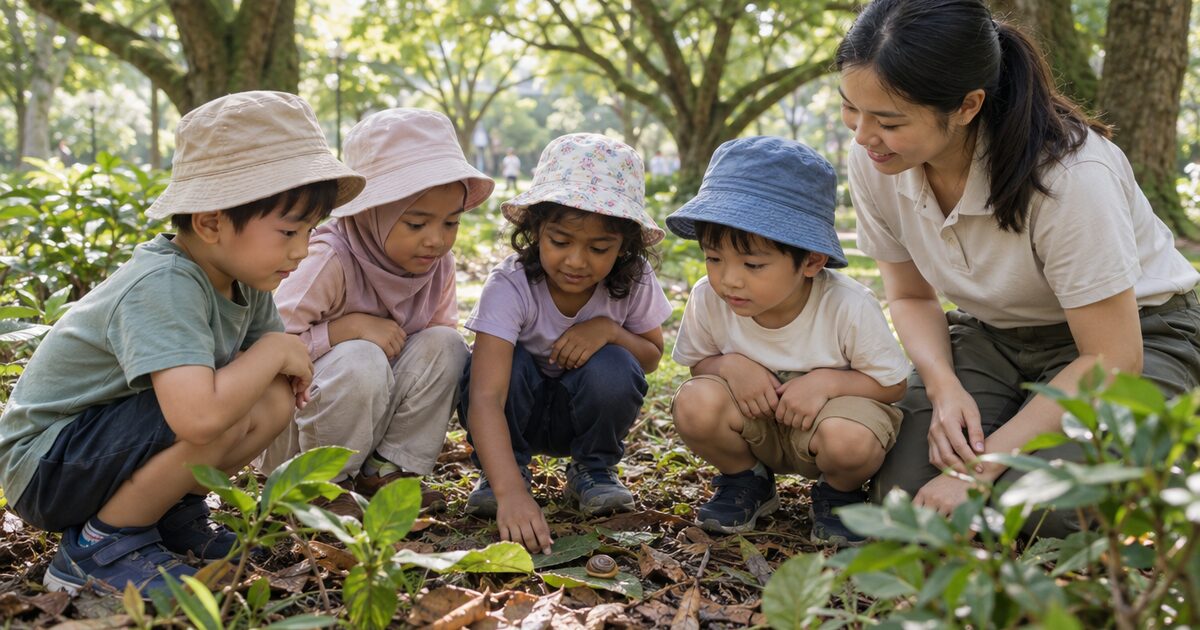
| What do children do outside? | Free play plus planned activities, like counting leaves or watching insects | Can I see photos or notes from outdoor time? |
| Who goes out with each class? | At least 2 adults, one of them a qualified teacher | Who on the team holds a first aid certificate? |
ECDA's Code also says centres must record each child's progress and share it with parents every 6 months. Outdoor learning should show up in those reports.
When to get help
- Outdoor time keeps dropping off the timetable: raise it with the teacher, then the principal. ECDA's Code says parents must get at least a month's written notice of changes to the programme plan.
- You think a centre isn't meeting the Code: call ECDA's hotline on 1800-111-2222 or email contact@ecda.gov.sg.
- Your child has a headache, nausea, dizziness or a high temperature after outdoor play in the heat: ECDA's Code lists these as early signs of heat injury and says to seek medical attention if they persist or worsen. See a GP or a polyclinic.
- Your child has asthma or another lung or heart condition: tell the centre. Its haze plan must identify these children and keep inhalers within reach.
- Your child seems far behind others in running, climbing or balance: tell the teacher, and raise it with your GP or polyclinic doctor.
Frequently asked questions
How do I find preschools with outdoor play in Singapore?
Shortlist by location on our preschool directory or ECDA's LifeSG preschool search. No public list rates outdoor play, so you find out on the visit. Go during outdoor time and use the questions above.
How much outdoor play in preschool does ECDA require?
For a full-day child, ECDA's Code asks for at least an hour of gross motor play a day, with 30 minutes or more outdoors daily, or 45 minutes outdoors three times a week. A half-day child needs at least one half-hour outdoor session a week. A few centres with no suitable outdoor space, named by ECDA, only have to go out once a month.
Does a forest school in Singapore need an ECDA licence?
If it runs as a preschool, it needs an ECDA licence and follows the same Code as any other centre. ECDA says preschools must not advertise, open or take payment without one, so ask to see it. A weekend or holiday nature class isn't a preschool. Ask that provider how many adults go out with each group and what happens in heavy rain.
What is a nature preschool or outdoor learning preschool in Singapore?
It's a name centres give themselves, and ECDA has no separate licence for it. Usually it means more time outside than the minimum, often in parks or gardens. Since ECDA wants outdoor learning in every preschool, compare the minutes and the places.
Will outdoor play in preschool get my child ready for Primary 1?
ECDA's Code says outdoor learning should support every area of learning, including language, literacy and numeracy. MOE's framework for ages four to six expects children to leave preschool with physical co-ordination and healthy habits. For the rest of the list, see how to prepare your child for Primary 1.
- ECDA, Early Childhood Development Centres Code of Practice, 5th edition 2026 (read 6 Nov 2026)
- ECDA, Choosing a preschool for your child (read 6 Nov 2026)
- ECDA, Outdoor Learning (read 6 Nov 2026)
- ECDA, Early Years Development Framework 2023 (read 6 Nov 2026)
- MOE, Nurturing Early Learners (NEL) Framework (read 6 Nov 2026)
- KKH, Singapore Integrated 24-Hour Activity Guidelines for Early Childhood, summary (read 6 Nov 2026)
- NParks, Learn by playing in nature (read 6 Nov 2026)
- ECDA, Contact us (read 6 Nov 2026)

Art classes for kids in Singapore: what to choose at each age
Art classes for kids in Singapore, age by age: what school art covers, free gallery options, what to watch in a trial, a...
7 min read
Best preschools in Singapore: how to choose a preschool by fees, hours, quality and curriculum
How to choose the best preschool in Singapore: ECDA fees for 1,795 preschools by operator type, hours and SPARK status, ...
14 min read
Bullying in preschool: the warning signs, what to say to your child, and how to escalate with a Singapore childcare centre
Bullying in preschool: how to tell it from rough play, the warning signs, what to say to your child, and the steps to es...
6 min read