

Night terrors vs nightmares: how to tell them apart and what to do
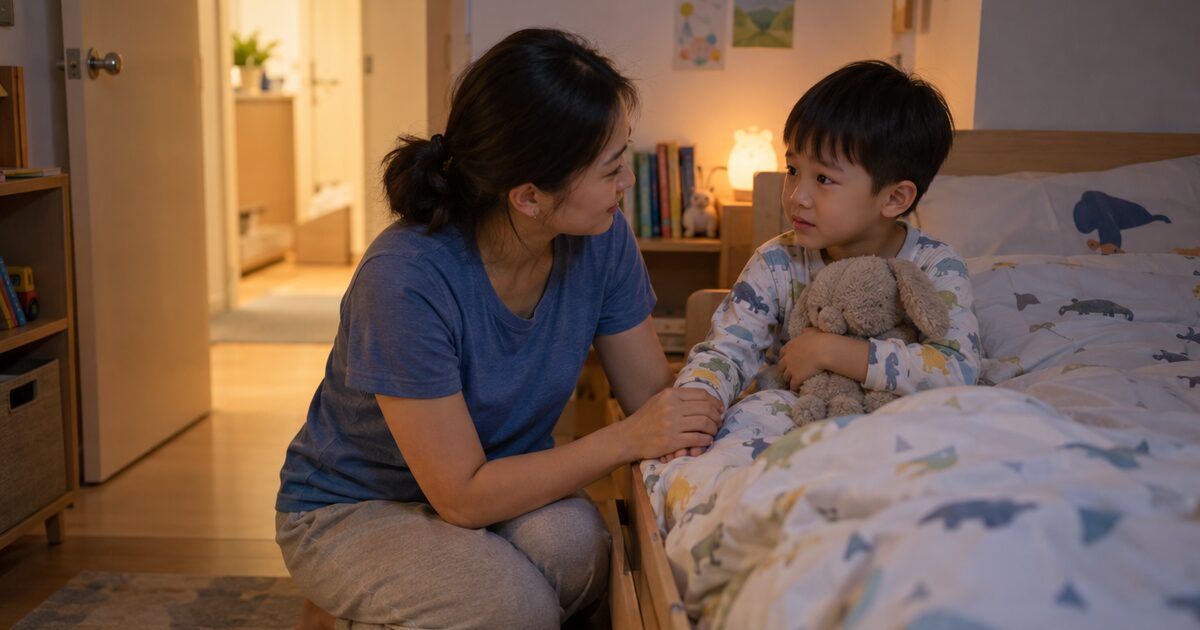
In this article
- What to do during a night terror, step by step
- Night terror or nightmare: how to tell them apart
- How to help after a nightmare
- When your toddler is afraid of the dark
- Why night terrors happen, and how to have fewer
- Child sleepwalking: keeping your child safe at home
- When to see a doctor
- Frequently asked questions
Night terrors vs nightmares comes down to one question: is your child awake? A nightmare wakes your child up. They remember it and they want you. In a night terror your child screams or thrashes with their eyes open, but they're still asleep and won't remember it. Stay close, keep them safe and let it pass without waking them.
What to do during a night terror, step by step
- Check the clock first: KKH says night terrors usually come in the first few hours after your child falls asleep, and nightmares in the last third of the night.
- Stay calm and wait it out, since KKH says most episodes last a few to five minutes and your child drops back to sleep on their own.
- Leave your child asleep, because the NHS says a child woken from a night terror may not recognise you and may get more upset.
- Save hugs and soothing words for a nightmare, as KKH says trying to calm a child mid-terror can make the reaction worse.
- Stay within reach and move hard things out of the way so your child can't get hurt, as the AAP advises.
- Steer your child gently back if they get out of bed; the AAP says most fall straight back to sleep because they were never awake.
- Jot it in a sleep diary next morning, as the NHS suggests: how long your child slept, how long they took to drop off and how they were that day.
- Try a planned wake-up if it comes at the same time each night. The NHS says to rouse your child 15 minutes before the usual time, every night for 2 weeks.
- Brief whoever does nights, whether that's your helper or a grandparent, since the AAP says babysitters should know what night terrors are and what to do.
Night terror or nightmare: how to tell them apart
The table uses KKH's guide to parasomnias in children unless it names another source. Nightmares are the more common of the two. KKH estimates night terrors affect 3 percent of children before puberty.
| Night terror | Nightmare | |
|---|---|---|
| When in the night | First few hours after falling asleep | Last third of the night, in dream sleep |
| Usual age | Usually starts at 2 to 4 | Can start at 6 months, most common at 3 to 12 (AAP) |
| Does your child wake? | No, even with eyes open (NHS) | Yes, often crying or afraid (AAP) |
| What you see | Sits up, screams, sweats, breathes fast, can't be calmed | Upset, and may struggle to fall back to sleep (AAP) |
| Remembers it? | Usually not | Yes, often vividly |
| How long | A few to 5 minutes; up to 15 minutes (NHS) | Ends when your child wakes |
| What to do | Stay close, keep them safe, don't wake them | Go to them, comfort them, let them talk about it (AAP) |
Some children have a milder version that KKH calls a confusional arousal. Your child sits up, moans or whimpers and seems confused, for a few minutes to half an hour. KKH says 5 to 15 percent of children have them, and they are usually harmless.
How to help after a nightmare
A cuddle fixes this one. Go to your child as quickly as you can, the AAP says, and remind them that dreams aren't real. KKH's advice is to hold them, let them talk about the dream if they want to, and stay until they're calm before you encourage them back to sleep.
The NHS lists being very tired or unwell, stress and something frightening, such as a scary film, as common causes. If evening shows might be the trigger, see our screen time guide.
When your toddler is afraid of the dark
KKH says night-time fears and nightmares are both common from age 1 to 3. Try these:
- Leave a dim night light on, or the hall light on with the door open, as HealthHub suggests.
- Look around the room together for whatever scares your child, such as shadows, and get rid of it, the AAP says.
- Offer a teddy bear or special blanket, which a KKH consultant writing on HealthXchange says may comfort an anxious child.
- Keep the room quiet and dark, with white noise if it helps, as the same consultant suggests. In a flat with thin walls it masks sudden noise, a trigger the NHS lists.
If the fear is really about you leaving the room, our guide to separation anxiety and starting childcare has a first-week plan. If bedtime turns into a battle, see our guide to toddler tantrums.
Why night terrors happen, and how to have fewer
KKH says parasomnias such as night terrors happen in otherwise healthy children. They come more often during illness or fever, stress or short sleep, and night terrors can run in families. The NHS adds sudden noises at night and needing to pee, which both disturb deep sleep.
KKH's main advice is a steady bedtime routine and schedule. Check your child's bedtime with our kids bedtime calculator, and see the toddler sleep guide for routines. Snoring matters too: KKH says broken sleep from problems such as obstructive sleep apnoea can make parasomnias worse. If your child snores, read our toddler snoring guide.
Child sleepwalking: keeping your child safe at home
KKH says sleepwalking usually starts between 4 and 6, and 15 to 40 percent of children sleepwalk at least once. Your child may sit up looking confused, then walk, with their eyes open. Guide them slowly and calmly back to bed without waking them, KKH says.
Then make the flat safe for the nights it happens:
- Lock the windows and the main door, as KKH advises. In an HDB flat that means the window catches, any window grilles, and the gate as well as the door.
- Keep the balcony and service-yard doors shut. The NHS says to keep doors and windows closed.
- Put a gate at the top of the stairs, as KKH advises, if you live in a maisonette or landed home.
- Clear the floor. The NHS says to remove anything your child could trip on.
- Lock away knives and tools. The NHS names sharp objects.
- Fit a door alarm if your child might leave the flat, as the NHS suggests.
- Skip the top bunk. The NHS says a child who sleepwalks shouldn't sleep there.
Our baby-proofing checklist covers the rest of the flat room by room. Moving to a big bed soon? The cot to bed guide has the bed safety checks.
When to see a doctor
Book a GP or polyclinic visit if you see any of these:
- Your child has night terrors more than once a week, or they go on longer than 30 minutes (Nemours KidsHealth).
- Your child drools, goes stiff or jerks during an episode, which KidsHealth lists as a reason to talk to your doctor.
- Injuries, or worry that your child will get hurt while sleepwalking (NHS).
- Snoring, especially with gasping or choking (HealthXchange), or breathing that stops and starts during sleep (NHS).
- Too much sleepiness in the daytime (HealthXchange).
- Night terrors that start after age 5 or carry on after 12 (NHS).
- Nightmares that are frequent, carry on after age 6, or follow a frightening event (NHS).
- Strong night-time fears that come with anxiety in the day (HealthXchange).
Start with your GP or polyclinic, who can refer your child on if needed. Our guide to sleep help in Singapore covers the hospital sleep clinics for children. If your child is hurt or seems seriously unwell, go to KKH or NUH Children's Emergency, or call 995.
Frequently asked questions
Are toddler night terrors dangerous?
The episode itself doesn't harm your child. The AAP says children are asleep and unaware of it, so the effect is on parents. The risk is a fall or a bump, so stay close. KKH says night terrors ease as children grow and rarely last beyond puberty.
Should I wake my child from a night terror?
No. KKH says a child woken during one will be disoriented and confused. The one exception is a planned wake-up before the usual time, which the NHS suggests when night terrors come at the same time each night.
My toddler is afraid of the dark. Is a night light OK?
Yes. HealthHub suggests a dim night light, or the hall light on with the door open. The AAP also says to let your child keep a light on if it helps them feel better.
Is child sleepwalking something to worry about?
Usually not. The NHS says sleepwalking doesn't usually need treatment, and most children grow out of it by their teens, so put your effort into a safe flat. See a doctor if it disrupts sleep, if you're worried about injury, or if your child is very tired in the day.
Can a fever cause night terrors?
It can make them more likely. KKH says parasomnias happen more often during illness or fever, stress and short sleep. The NHS also lists being very tired or unwell.
Do night terrors need medicine?
Rarely. KKH says reassurance and education are enough in most cases, and medicines are rarely needed. If you're thinking about melatonin, read our melatonin guide and talk to your doctor first.
- KK Women's and Children's Hospital, Parasomnias in Children (read 6 Nov 2026)
- KK Women's and Children's Hospital, Sleep (Child) (read 6 Nov 2026)
- HealthXchange (SingHealth), How to Cultivate Good Sleep Habits in Children (read 6 Nov 2026)
- HealthHub, Parent Hub: 3-6 Years - Good Sleep Captain Sleep (read 6 Nov 2026)
- NHS, Night terrors and nightmares (read 6 Nov 2026)
- NHS, Sleepwalking (read 6 Nov 2026)
- American Academy of Pediatrics (HealthyChildren.org), Nightmares, Night Terrors and Sleepwalking in Children (read 6 Nov 2026)
- Nemours KidsHealth, Night Terrors (read 6 Nov 2026)

Melatonin for kids in Singapore: what to try first, and when to ask a doctor
Melatonin for kids in Singapore: what KKH and HSA say, why doctors start with sleep habits, how to store gummies, and wh...
7 min read
Toddler sleep from 1 to 6: how much they need, when naps stop, and how to settle them step by step
Toddler sleep for ages 1 to 6 in Singapore: hours a day from the national guidelines, when naps stop, sample bedtimes an...
8 min read
Toddler snoring: what's normal, what to do and when to see a doctor
Toddler snoring with a cold is common. Loud snoring most nights, gasps or pauses need a doctor. Steps to take, sleep apn...
8 min read