
Art and craft for preschoolers: easy ideas by age, using things you already have at home
In this article
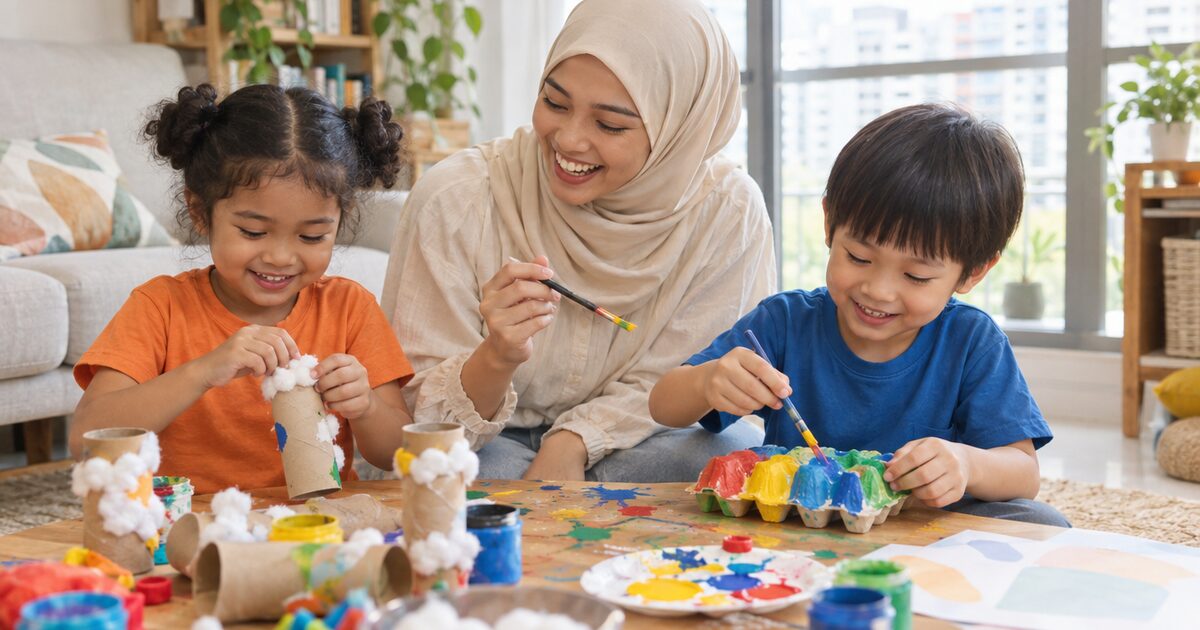
The best art and craft for preschoolers uses things you'd otherwise throw away: toilet rolls, egg cartons, cereal boxes, old magazines, ice-cream sticks and leaves from the void deck garden. For 2 to 3-year-olds, keep it big and messy, like finger painting, tearing and sticking, and sponge stamps, and leave out anything small enough to swallow; HealthHub says small items are a choking hazard under age 3. From about 3, children can handle glue sticks, child-safe scissors with help, and simple puppets and masks. By 5 and 6, they can follow steps to make binoculars, a tissue-box guitar or a lantern for Mid-Autumn. Below are 15 ideas sorted by age, a supplies checklist you can print, and the safety points that matter most.
Why art and craft matter at this age
Singapore's preschool curriculum treats art as a proper learning area. MOE's Nurturing Early Learners (NEL) framework, which shapes preschool curriculum for children aged four to six, lists aesthetics and creative expression among its learning areas: children should enjoy art, express ideas and feelings through it, and learn to appreciate it. The same framework names control and coordination in fine motor activities as a goal. Cutting and gluing practise exactly that, and so do threading and stamping. For under-3s, ECDA's Early Years Development Framework puts the weight on four areas: cognitive, communication and language, physical, and social and emotional development.
What that means at home: the process matters more than the result. A three-year-old who spends 20 minutes deciding where every scrap of paper goes has learned more than one whose parent tidied the collage. MOE's advice to parents is to encourage children to explore and ask questions beyond school, and a box of recyclables does that well. For more free ideas sorted by age and skill, see our learning activities for preschoolers.
Art and craft ideas by age
| Activity | Best age | What you need | What it practises |
|---|---|---|---|
| Finger painting on newspaper | 2 to 3 | Washable paint, old newspaper or a tray | Senses, colour, arm movement |
| Paint in a bag (mess-free) | 2 to 3 | Zip bag, a few blobs of paint, tape to fix it to the table | Squishing and mixing colours without the mess |
| Tear and stick collage | 2 to 3 | Old magazines, glue stick, a cereal box panel | Finger strength and choosing where things go |
| Sponge stamps | 2 to 3 | Kitchen sponge cut into shapes, paint on a plate | Grip, pressing, patterns |
| Cotton wool clouds | 2 to 3 | Cotton wool, glue and blue paper | Pinching, texture |
| Toilet roll flower stamps | 3 to 4 | Toilet rolls snipped at one end, paint | Cause and effect, shapes |
| Paper plate animal masks | 3 to 4 | Paper plates, crayons, wool or paper strips, an ice-cream stick handle | Drawing faces and pretend play |
| Leaf rubbings | 3 to 4 | Leaves from the park or void deck, crayons with the paper peeled off, thin paper | Observation, steady pressure |
| Egg carton caterpillar | 3 to 4 | One row of an egg carton, paint, a pipe cleaner | Painting small areas and counting segments |
| Ice-cream stick puppets | 3 to 4 | Ice-cream sticks, card, crayons, glue | Cutting with help, then telling a story |
| Toilet roll binoculars | 4 to 6 | Two toilet rolls, tape, string, stickers | How to measure, join and decorate |
| Tissue box guitar | 4 to 6 | Empty tissue box, rubber bands, a kitchen roll tube | Sound, plus stretching and fixing |
| Cereal box HDB block | 4 to 6 | Cereal box, paper squares for windows, markers | Shapes, counting floors, local life |
| Sewing card | 4 to 6 | Cardboard with punched holes, a shoelace | Fine motor control, patterns |
| Paper cup lantern for Mid-Autumn | 4 to 6 | Paper cups or coloured paper, scissors, string, a battery tea light | Cutting lines and following steps |
Ages are a guide. A careful two-year-old may love leaf rubbings; an impatient five-year-old may want finger paint. Follow their interest.
How to run each age group
Ages 2 to 3: big, messy and supervised
Toddlers explore with their whole hand and, often, their mouth. Choose big materials, set out small amounts, and stay beside them. HealthHub's toy-safety advice applies to craft supplies too: avoid buttons, coins, pins and marbles, which can make young children choke, and painted items for children who still mouth things. Keep sessions short, 10 to 15 minutes is plenty, and stop when they lose interest.
Painting in the bathroom, or on the kitchen floor with a tray, makes clean-up easier. An old adult T-shirt makes a good smock.
Ages 3 to 4: tools and pretend play
This is when glue sticks, chunky crayons and child-safe scissors come in. Cut with them at first, then let them try short snips on strips of paper. Many crafts at this age turn into props, so let the craft lead to play: a mask becomes a tiger, a puppet tells a story.
Ages 4 to 6: steps and projects
Older preschoolers can follow two or three steps, wait for glue to dry and finish a project another day. Festivals make good themes: lanterns for Mid-Autumn, red packets turned into fish or fans for Chinese New Year, and flags or an HDB-block cityscape for National Day. Ask questions instead of correcting: "What's happening in your picture?" works better than "That's not what a cat looks like."
Easy toddler crafts at home, step by step
- Pick one craft from the list below that matches what your child can do now.
- Set it all up before you bring your child over. Tape the paper down and put out one or two crayons, or a small blob of paint on a plate.
- Cover the floor with a flattened delivery carton or old newspaper. A tiled floor near the kitchen sink makes spills easy to wipe.
- Clear away anything small. CPSO's toy safety tips say not to buy toys with "any part that can fit into a child's mouth, nose, or ear", and the same test works for craft bits. The safety section below has the full list.
- Show your child once, then hand it over. KKH's play brochure says to play with your child "but do not take over, let your child change the game".
- Stay beside your child the whole time, because KKH says very young children need supervising at all times during play.
- Stop while it's still fun: if your child wanders off or starts chewing the crayon, pack up and try again another day.
- Tidy up together. SGH lists copying household chores from 18 to 19 months, so give your child a job, like putting the crayons back in the box. Then check the floor for small bits, as CPSO advises after play.
KKH's play brochure, written by its Department of Child Development, says toddlers aged 1 to 2 have a short attention span and need lots of changes of activity. Their hand skills are still early, too. SGH lists scribbling from 15 to 18 months and copying a vertical stroke at 24 months. So a toddler craft is about making marks and pressing things down, not following steps. Each craft in the list below suits a 2 year old or a younger toddler, and needs only what most Singapore homes already have. The ages come from SGH, KKH and the US CDC's milestone pages. For play beyond crafts, see learning through play for toddlers.
- Crayon scribbles, from about 15 to 18 months: chunky washable crayons on the back of old wrapping paper, taped to the floor so it stays put.
- Water painting on floor tiles, from about 18 months: a thick paintbrush and a cup with a little water, with nothing to clean once it dries.
- Sticky collage, from about 2 years: clear book-wrapping plastic taped sticky side up, with torn paper, old red packets and fallen leaves to press on.
- Body tracing, from about 2 years: trace round your child on a flat carton.
- Toy car tracks, from about 2 years: roll a plastic toy car through washable paint on a plate and across paper laid inside a baking tray, which keeps the paint in one place.
- Old toothbrush painting, from about 2 years: an old toothbrush and a dab of washable paint, used over paper in the same tray so the splatter stays on the paper and off the floor, the walls and your child's clothes.
- Carton box house, from about 30 months: a big delivery carton to colour with crayons, or with washable paint if you don't mind a bigger clean-up.
Supplies checklist
Home art and craft supplies
Keep in a box
Save from the recycling
Keep away from under-3s
Safety: what matters most
- Under 3, leave out anything small enough to swallow. HealthHub says small toys are a choking hazard below age 3 and should be kept away from younger siblings. The American Academy of Pediatrics also lists pen and marker caps, and warns that balloons are a choking risk up to age 8.
- Don't use water beads or small magnets for sensory play. Singapore's Consumer Product Safety Office says neither can be sold as toys for children under 14, and advises against using them as sensory toys. KKH reported cases of children swallowing magnets rising from 26 in 2019 to 38 in 2021, and water bead cases from one to seven. One of them was a one-year-old who choked on a bowl of water beads.
- Watch string and ribbon, which HealthHub flags as a strangulation risk.
- Buy art supplies made for children and read the labels. The US Consumer Product Safety Commission suggests avoiding old or unlabelled supplies, products in aerosol cans, and high-temperature glue guns; use a low-temperature glue gun yourself if you need one.
- Keep food and drinks off the craft table, give small amounts at a time, and wash hands afterwards. Adults should mix any powdered paint, the same guide says.
- Check the floor and table for small pieces when you tidy up.
If your child swallows a magnet or a battery, CPSO says to get emergency medical help straight away. For any choking, call 995. Our guide to safe toys by age covers Singapore's toy safety rules in more detail.
Making it easy in a small flat
- Keep a single craft box, so set-up and clean-up take two minutes.
- Lay newspaper on the floor, or paint in the bathroom where splashes wash off.
- Do one activity at a time, and leave it out to finish later if your child is enjoying it.
- Show off the results: tape them to a wall or the fridge, or photograph them and recycle the originals once a month.
On rainy or hazy days, our haze guide has more indoor ideas, and easy science experiments at home uses the same kitchen supplies. If you'd rather someone else handled the mess, try art jamming in Singapore. For balancing guided crafts with open play, see free play vs structured play, and for holiday plans, our school holiday activities list.
Frequently asked questions
What art and craft can a 2-year-old do?
Big, simple activities: finger painting, paint in a bag, tearing and sticking magazine paper, sponge stamps and cotton wool pictures. Stay close, and leave out anything small enough to swallow, which HealthHub says is a choking hazard under age 3.
What craft materials are unsafe for toddlers?
Buttons, beads, coins, marker caps, uninflated balloons, small magnets and water beads. Singapore's CPSO says water beads and magnetic balls can't be sold as toys for under-14s, and KKH has seen cases of children swallowing both rise.
How do I keep crafts from making a mess in an HDB flat?
Use a tray or old newspaper, put out small amounts of paint, dress your child in an old T-shirt, and paint in the bathroom if you can. A single craft box makes tidying quick.
Do preschools in Singapore teach art?
Yes. MOE's Nurturing Early Learners framework includes aesthetics and creative expression as a learning area for children aged four to six, alongside fine motor skills.
What can I make from recycling with my preschooler?
Toilet roll binoculars or flower stamps, an egg carton caterpillar, a tissue box guitar, a cereal box HDB block, and paper plate masks. Wash containers first, and keep small items like bottle caps for over-3s.
What toddler crafts suit an 18 month old?
Crafts that are mostly making marks. SGH lists scribbling from 15 to 18 months and suggests giving your child crayons or markers to try on paper, so chunky washable crayons on a big taped-down sheet suit this age. Painting floor tiles with a brush and a little water works too. SGH lists no attempt to scribble by 18 months as a sign to watch, and our toddler milestones guide covers who to ask.
What are no mess crafts for toddlers and 2 year olds?
Water painting on floor tiles leaves nothing behind once it dries. Crayon scribbles, body tracing and a sticky collage on book-wrapping plastic need no paint or glue. For crafts for 2 year olds that do use paint, like toy car tracks, keep the paper inside a baking tray so the paint stays in one place.
- MOE - Nurturing Early Learners (NEL) Framework (read 11 October 2026)
- ECDA - Early Years Development Framework (read 11 October 2026)
- HealthHub (HPB) - The toy story on safety (read 11 October 2026)
- Consumer Product Safety Office - Safety tips on children's toys (read 11 October 2026)
- Consumer Product Safety Office - Safety tips on small magnets (read 11 October 2026)
- KKH - More children accidentally swallowing objects, 31 July 2023 (read 11 October 2026)
- American Academy of Pediatrics (HealthyChildren.org) - Choking prevention (read 11 October 2026)
- US CPSC - Art and craft safety guide (read 11 October 2026)
- KK Women's and Children's Hospital, Playing With Your Child (brochure) (read 7 Nov 2026)
- Singapore General Hospital, Developmental milestones 12 to 18 months (read 7 Nov 2026)
- Singapore General Hospital, Developmental milestones 18 to 24 months (read 7 Nov 2026)
- US CDC, Milestones by 2 years (read 7 Nov 2026)
- US CDC, Milestones by 30 months (read 7 Nov 2026)
Admiralty Park Family Guide: Singapore's Playground With the Most Slides
Family guide to Admiralty Park, the Singapore playground with the most slides. Play zones by age, inclusive swings, mang...
11 min read
Archery in Singapore: A Family Guide to Beginner Sessions for Kids
Archery in Singapore for families: how beginner sessions work, suitable ages for kids, indoor vs outdoor ranges, safety ...
9 min read
ArtScience Museum Family Guide: Future World, Tickets and Tips for Singapore Parents
A Singapore parent's guide to the ArtScience Museum: Future World with kids, tickets, the Family Friday free-child deal,...
9 min read