

When your child cannot handle losing: what to do and say
In this article
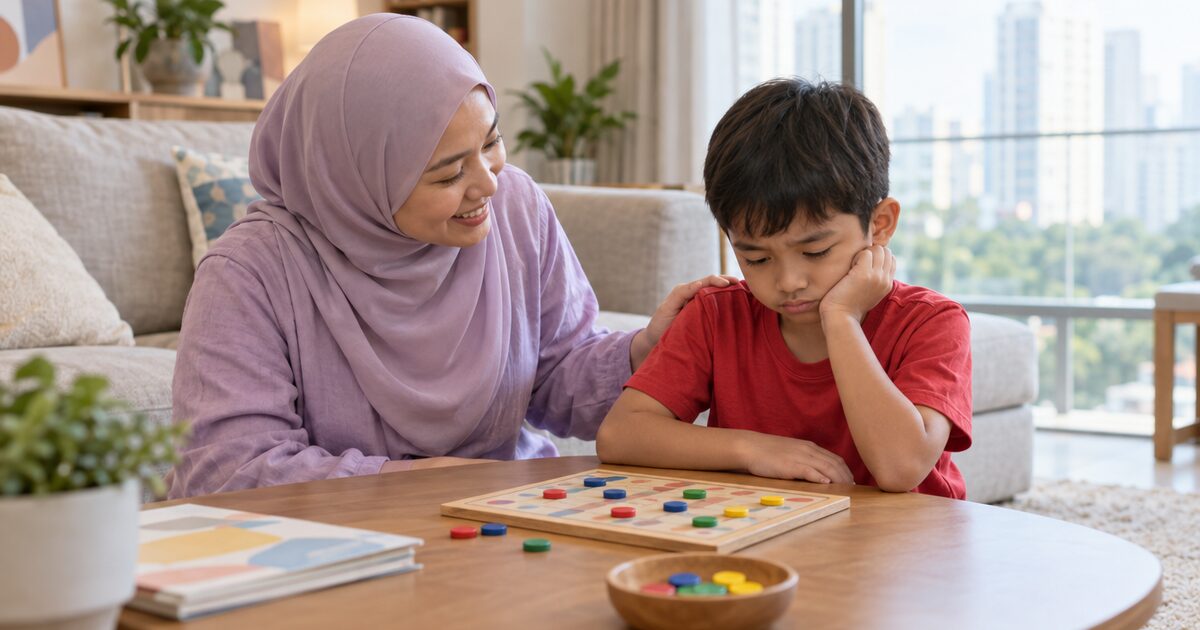
If your child cannot handle losing, you can teach it the way you teach sharing or tying shoes: a bit at a time, with lots of practice. Families for Life, the family council under the Ministry of Social and Family Development, says being disappointed after losing a race or a board game is common and natural for young children. Stay calm, name the feeling, praise the effort and play again soon.
What to do when your child can't handle losing, step by step
- Steady yourself first. HealthHub's MindSG pages say staying calm helps you work out what set your child off.
- Get down to eye level and name the feeling. HealthHub suggests kneeling or squatting first, then giving the words: "You really wanted to win. You're cross."
- Let the feeling land before you teach anything. Families for Life says don't hurry to brush it aside, and HealthHub notes children name feelings better once they're calmer.
- Keep a kind, firm limit on hurting, with words like "You can be angry, but you can't throw the cards." HealthHub says feelings shouldn't come out in ways that hurt others.
- Offer a way to calm down. HealthHub suggests pretending to blow out a birthday candle, and the CDC suggests a calm-down spot with you close by.
- Keep playing, and let some games end in a loss. HealthHub says letting children make mistakes early helps them become more resilient, so don't rush to the rescue.
- Show them how to lose: when you lose, say "Good game, well done" and tell them what you enjoyed about playing, as Families for Life suggests.
- Praise the effort over the score, with something like "You kept trying when it got hard" in place of "Well done for winning." Families for Life says praising wins teaches children that winning is what really matters.
- Practise with short, simple games, since the CDC suggests simple board games, card games or Simon Says to teach game rules to 5-year-olds.
Why losing feels so big
A lost game hits before your child has the words or the self-control to handle it. HealthHub says toddlers who can't yet say what they feel may throw tantrums or cry. It also says children flare up fast, and most get over the heat of the moment quickly. So the storm after a lost game usually passes sooner than it feels.
It gets easier with age and practice. The CDC lists following rules or taking turns in games with other children as a milestone by 5 years, which means most children (75% or more) can do it by then. If big meltdowns happen over much more than games, our guide to toddler tantrums covers the wider picture.
| Age | What you may see | What helps |
|---|---|---|
| Toddlers | Crying or a tantrum when the game ends. HealthHub says toddlers who lack the words may react this way. | Stay calm, get to eye level and name the feeling. |
| Preschoolers | Tears after losing a race or board game. Families for Life calls this common and natural for young children. | Cooperative games, or games where nobody keeps score. |
| By 5 years | Most can follow rules and take turns in games, says the CDC. Losing can still sting. | Simple board and card games, with a calm-down spot nearby. |
| Primary school | Tantrums or quitting halfway. Families for Life says you may need to step in. | A short chat after the game about skills and fun, with no comparing. |
Praise effort and strategy over winning
What you praise is what your child learns to chase. Families for Life says that if you focus on goals scored or games won, your child learns that winning is what matters. It suggests a short chat after the game about a skill they're improving or the fun they had. Lines like these work:
- "You kept going even when you were behind."
- "That was a clever move. How did you think of it?"
- "What would you try next time?"
- "You shook hands even though you were sad. That was kind."
HealthHub adds two things. Don't compare your child with other children, and when they don't do well, praise the effort and talk through how to improve step by step. That matters if your child does enrichment classes, sports or competitions. Schools have moved the same way. MOE announced in 2018 that from 2019, Primary 1 and 2 pupils would have no weighted assessments or exams, and report books would drop class and level positions to discourage excessive peer comparisons. For schoolwork pressure later on, see how to motivate your child to study, and our list of phrases not to say to kids has better swaps.
How to build your child's confidence
Confidence grows when your child does real things and sees that they can. HealthHub suggests giving your child manageable tasks to finish alone, then praising them when they're done. The CDC says most 5-year-olds can do simple chores like matching socks or clearing the table. Cooking counts too: HealthHub says small jobs like kneading dough or pouring a mixture build a child's confidence. Our chores for kids by age list has more ideas.
Let your child try a few different activities, so they find something they're good at. A KKH psychologist quoted by HealthHub says not to rush to your child's rescue, but to watch for unusual stress, which may mean the task is beyond them for now. When you correct your child, leave out labels like "lazy" or "naughty", because HealthHub says to help your child see that the problem is the behaviour and that they themselves are fine.
Teaching your child to be assertive
Being assertive means saying what you want in a firm, polite voice, without grabbing or shouting. It helps in games too, when your child wants a fair turn. MOE Schoolbag describes one primary school that teaches pupils to say "Stop, I feel (emotion) when you (action)" in a polite and assertive tone, then walk away and get help from a trusted adult. Give your child a few short lines to practise at home:
- "Stop, I don't like that."
- "My turn next."
- "Can I play too?"
- "Let's check the rules."
Schoolbag suggests trying out different tones of voice together, so your child feels sure saying them. Act it out with soft toys, then swap roles. If another child keeps hurting or leaving yours out, our guide to bullying in preschool has the next steps.
Use the same words at home, with grandparents and the helper
If one adult lets your child win every game and another doesn't, your child gets mixed messages. HealthHub says clear, consistent rules make it easier for a child to know what's expected. Agree a short plan with everyone who plays with your child. Let some games end in a loss, use the same calm-down words, and praise effort the same way. Write the lines down for your helper or grandparents, and pick one quiet corner of the flat where your child can cool off with an adult close by. Losing to a brother or sister can sting more, so see our guide to sibling rivalry too.
When to get help
Talk to your GP, polyclinic doctor or paediatrician if you see any of these:
- Worry or fear gets in the way of school, friends or play. HealthHub says a healthcare professional should be consulted when anxiety interferes with daily life, and that without help it can often worsen.
- Your child avoids anything they might lose at or get wrong. HealthHub lists avoiding situations that cause fear as one way an anxiety disorder affects children.
- Your child often says they're no good at anything. HealthHub lists this, along with getting frustrated easily, as a sign of low self-esteem.
- Big feelings come often and your child struggles to calm down. HealthHub's MindSG lists both as signs a child is overwhelmed by emotions.
HealthHub has a downloadable list of community mental health services that also shows your nearest GP. For a preschooler, tell the teacher what you're seeing at home. In primary school, the school counsellor can help, and HealthHub suggests making sure your child knows they can talk to their teacher or counsellor. Our child mental health guide explains where to go in Singapore, and the paediatrician map finds one near you. If losing often ends in hitting, read child hitting and aggressive behaviour.
Frequently asked questions
Why can't my child handle losing?
Losing brings up big feelings, and young children don't yet have the words or self-control to manage them. HealthHub says toddlers who can't say what they feel may cry or have tantrums. Families for Life calls disappointment after losing common and natural for young children. It eases with practice and calm support.
Should I let my child win at board games?
Now and then is fine, but not every game. HealthHub says letting children make mistakes early helps them become more resilient. Pick short games your child can sometimes win fairly, and try cooperative games where you're on the same side, as Families for Life suggests.
How can I build my child's confidence?
Give your child real jobs they can finish, like clearing the table or helping to cook, and praise them when they're done, as HealthHub suggests. Praise effort and new ideas over results. Let them try different activities so they find their strengths.
How do I teach my child to be assertive?
Teach a few short, polite lines like "Stop, I don't like that" and "My turn next", and practise them in different tones of voice, as MOE Schoolbag suggests. Role-play with toys so your child gets used to saying them. Praise them when they use the words in real play.
Is it normal for a 5 year old to cry after losing?
Yes. Families for Life says disappointment after losing is common and natural for young children. The CDC says most children can follow rules and take turns in games by 5, but following rules isn't the same as feeling fine about losing. Keep games short, stay calm and notice good sportsmanship when you see it.
- Families for Life, 4 Ways to Help Your Child Be a Gracious Loser (read 6 Nov 2026)
- HealthHub MindSG, My Child: Managing Emotions (read 6 Nov 2026)
- HealthHub, Building Resilience in Your Child (read 6 Nov 2026)
- HealthHub, 8 Ways to Boost Your Child's Confidence and Self-Esteem (read 6 Nov 2026)
- HealthHub MindSG, My Child: Managing Anxiety Disorder (read 6 Nov 2026)
- MOE Schoolbag, Four strategies to help your child navigate bullying situations (read 6 Nov 2026)
- MOE, Learn for Life: Preparing our students to excel beyond exam results, press release 28 Sep 2018 (read 6 Nov 2026)
- CDC, Important Milestones: Your Child By Five Years (read 6 Nov 2026)
ADHD in children in Singapore: early signs, assessment and support
ADHD in children in Singapore: how it differs from a lively preschooler, when doctors assess it, the polyclinic route an...
9 min read
Asthma in children in Singapore: signs, inhalers and what to do in an attack
Asthma in children in Singapore: the signs, reliever and preventer inhalers, using a spacer, the action plan, and when t...
8 min read
Balanced diet for toddlers in Singapore: plates, servings, sugar, tea and salt
A balanced diet for toddlers in Singapore: HPB's plate, daily servings for ages 1 to 6, hawker picks, and the advice on ...
9 min read