

Toddler exercise and active play: how much your child needs, with ideas by age
In this article
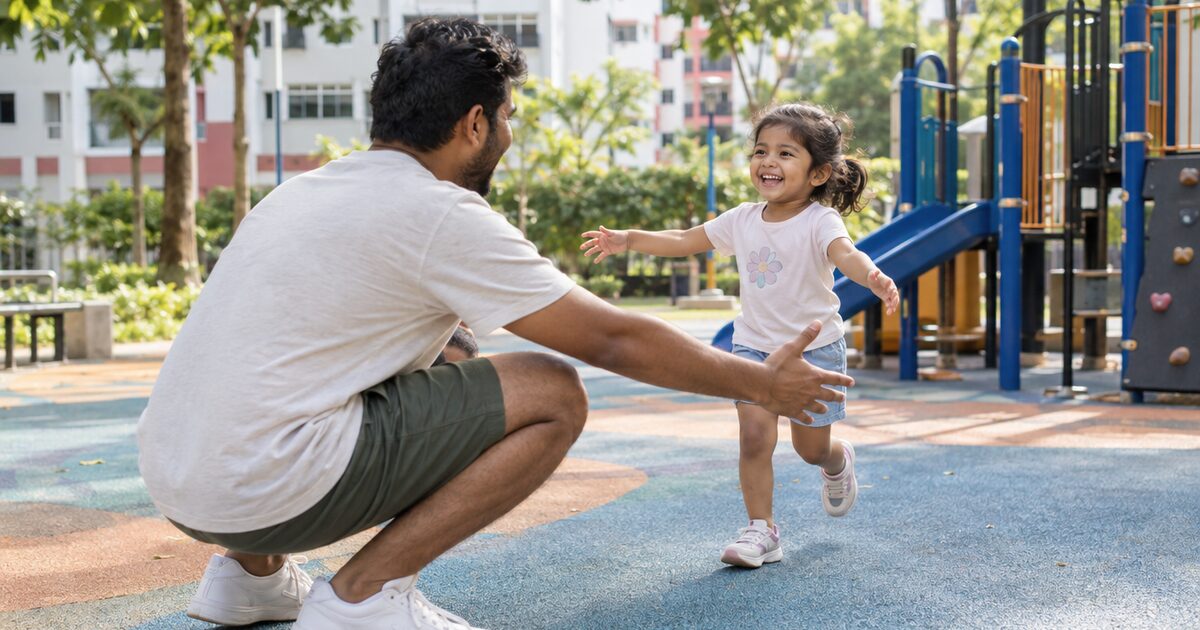
Your toddler needs at least 180 minutes of moving about a day from age 1, at any pace. From age 3, at least 60 of those minutes should be energetic enough to leave your child puffing. Those numbers come from Singapore's 24-hour activity guidelines for under-sevens. For a toddler, exercise means play, and a walk to the void deck counts.
How to get your toddler moving every day, step by step
- Aim for at least 180 minutes of movement a day in short bursts, the amount Singapore's 24-hour guidelines set from age 1.
- Make 60 of those minutes energetic once your child turns 3. HPB's test on HealthHub: in moderate play your child can talk in short sentences but can't sing.
- Take your child outdoors every day, which the guidelines highly encourage; HealthHub adds that time outside can help prevent or delay myopia.
- Unbuckle your toddler within the hour, because the guidelines say no more than 1 hour at a time strapped in a seat. The WHO counts prams and high chairs too.
- Swap screen time for play: the guidelines advise no screens before 18 months and under 1 hour a day after that. Our screen time guide has ways to cut back.
- Ask grandparents or your helper to play along with you, since the guidelines say caregivers should actively take part in toddlers' physical play.
- Walk with your toddler instead of taking the bus, and use the stairs instead of the lift, as HealthHub suggests.
- Check the heat stress level on the myENV app before long outdoor play, and give water breaks every 20 to 30 minutes, as a KKH dietitian advises.
How much physical activity does a toddler need?
The Singapore Integrated 24-Hour Activity Guidelines for Early Childhood came out in January 2022 from the College of Paediatrics and Child Health. A KKH-led team developed them as the country's first integrated activity guidelines for early childhood, and they cover the whole day, from play to sleep.
| Age | Active play a day | Energetic play | Sitting and screens | Sleep a day |
|---|---|---|---|---|
| 1 to 2 years | At least 180 minutes, any pace | No set amount; more is better | No more than 1 hour at a time strapped in a seat. No screens before 18 months, under 1 hour a day after | 11 to 14 hours |
| 3 to 4 years | At least 180 minutes | At least 60 minutes, preferably outdoors | Break up long spells of sitting. Recreational screens under 1 hour a day | 10 to 13 hours |
| 5 to 6 years | At least 180 minutes | At least 60 minutes, plus muscle- and bone-strengthening play several times a week | As for 3 to 4 years | 10 to 13 hours at 5; 9 to 11 hours at 6 |
Light play counts for toddlers. HealthHub, writing with a KKH paediatrician, says the intensity matters less at this age than the amount. The WHO's 2019 guidelines for under-5s give the same 180 minutes, with 60 energetic minutes from age 3.
Plenty of parents guess wrong. In a KKH survey of 340 parents of under-sevens, more than half underestimated or overestimated the activity children need. The kids bedtime calculator helps you fit the sleep hours around your wake-up time.
What does your child get from it? HPB lists better movement skills and balance, sharper thinking, a healthier heart, stronger bones and muscles, and steadier emotions. There's more on the brain side in how to boost your child's brain development.
Toddler exercise ideas by age
Pick two or three a day and repeat the ones your child loves. HealthHub suggests letting your toddler choose where and what to play.
For 1 to 2 year olds:
- Roll a ball back and forth on the floor. HealthHub says to start ball skills with rolling and work up to throwing and catching.
- Keep a balloon in the air with hands and knees.
- Build a tunnel of sofa cushions to crawl through, then a small obstacle course of household things to climb over.
- Walk on grass and step on leaves at the park, and let your toddler run about freely, as HealthHub suggests.
- Dance to the songs your family already sings, in any language.
For 3 to 4 year olds:
- Make a hopscotch grid on the floor with masking tape.
- Throw and catch with a soft sponge or beanbag, which HealthHub says small hands grip more easily than a ball.
- Walk backwards, then on tiptoes, then with giant strides.
- Play traffic lights around the flat: you call red or green, and your child stops or runs.
- Ride a tricycle along the void deck, where the floor is flat and out of the sun.
- Play hide and seek or tag at the playground, which HealthHub counts as moderate to vigorous play.
For 5 to 6 year olds:
- Skip rope or climb to build muscle, and do hopscotch or dance to build bone. The guidelines want this kind of play several times a week from 5.
- Try cycling, gymnastics, swimming or ball games, all of which HealthHub lists for preschoolers.
- Act out a sport, like badminton, and let your child guess it. Then swap.
- Learn a game from ActiveSG's 57 Kampung Games, old kampung games reworked to build young children's movement skills.
- Hand your child a broom when you sweep, since HealthHub counts sweeping and mopping as movement.
For play that builds words and thinking too, see learning through play. If you're weighing free play against classes, read free play vs structured play.
Active play in an HDB flat and around the estate
You don't need a big room. HealthHub suggests a safe zone for movement in one corner of the flat, so move the coffee table, put down a mat and let your child roam.
Downstairs, the void deck works as a track for tricycles and ball games. Neighbourhood playgrounds add climbing, and our playground guide lists the bigger ones. NParks says the park connector network has more than 380 km of trails. Find your nearest stretch. For longer outings, see family nature trails or things to do with kids.
At the playground, HPB and KKH's playground safety tips say to supervise at all times and skip clothes with cords or drawstrings. They also say not to go down a slide with your child on your lap. For bikes and rollerblades, HPB's Grow Well SG page says to make helmets and knee and elbow pads a habit.
If grandparents or a helper look after your child on weekdays, share the plan with them, and invite grandparents on walks as HealthHub suggests. Ball games and follow-the-leader work in any language, and some grandparents will remember kampung games of their own. HealthHub also suggests walking to a nearby hawker centre or mall instead of ordering in.
Heat, rain and haze
Before a long spell outside, check the heat stress level on the myENV app or weather.gov.sg. MSE and NEA, who run the advisory, ask you to weigh age and health as well. A KKH dietitian says children don't cool down as well as adults. Offer water every 20 to 30 minutes when they're active outdoors, because young toddlers can't tell you they're thirsty.
When it rains, keep off the playground, where the HPB and KKH tips say children may slip and fall. Move the minutes indoors, or go somewhere cool. HealthHub names indoor playgrounds as a way to stay active without overheating, and our indoor play areas guide sorts them by age and area.
On haze days, follow your preschool's lead. NEA says preschools cut prolonged outdoor play and strenuous indoor activity once air quality reaches the Unhealthy range.
Family sports in Singapore
From age 4, HPB's Active Family Junior runs guided parent-and-child sessions every weekend around the island. Its activity list includes mini tennis and inline skating. You book on the Healthy 365 app, where registration opens 28 days before each session.
Swimming works for the whole family. Our public swimming pools guide covers ActiveSG complexes, and swimming lessons for kids covers when to start. When your child is ready for a coach, kids sports classes is the next step. Around water, keep these habits:
- Stay within arm's length of a toddler in or near water, bath time included, as the AAP advises.
- Get in the pool with your child, and take them with you when you get out, even with lifeguards on duty (AAP).
- Keep your phone in your bag; HPB and KKH's water play tips name phones and reading as distractions.
- Use a proper life jacket when one is needed, since the same tips say air-filled swimming aids can't replace it.
- Leave the pool when bad weather comes in, as those tips also advise.
When to get help
Movement skills come at different speeds. NUH's Child Development Unit lists these signs as worth raising with your polyclinic or GP:
- Not running at 2 years
- Not throwing or kicking a ball, or not jumping off a low step, at 2 and a half
- Falling down a lot at 3
- Not pedalling a tricycle, or not standing on one foot for 5 seconds, at 4
- Using one arm or leg much more than the other, at any age
- Losing a movement skill your child already had
Before each well-baby visit, fill in the Child Health Booklet checklist, which HealthHub says covers gross motor skills. If the doctor has concerns, they can refer your child to KKH's Department of Child Development or NUH's Child Development Unit. If your child has a health condition, HealthHub says to ask their doctor for exercise advice first. For weight, see childhood obesity in Singapore; for every milestone, see toddler milestones.
Frequently asked questions
How much physical activity does a toddler need?
At least 180 minutes a day from age 1, at any pace and spread through the day. That's Singapore's 24-hour guideline, and the WHO uses the same figure. From age 3, at least 60 of those minutes should be moderate to vigorous. HealthHub says short bursts of 10 to 20 minutes add up.
What are easy toddler exercise ideas for a small flat?
Balloon keep-up and masking-tape hopscotch both fit a living room, and HealthHub suggests cushions for a safe game of catch. An obstacle course of pillows works too, and so does dancing.
Does a stroller ride count as toddler exercise?
Not really. The WHO counts time in a pram or stroller as restrained time, and Singapore's guidelines say a toddler shouldn't be strapped in a seat for more than 1 hour at a time. Let your child walk part of the way, or stop at a playground on the route.
Where can we do family sports in Singapore with a preschooler?
HPB's Active Family Junior runs weekend sessions for children aged 4 to 6 with a parent, booked on the Healthy 365 app. ActiveSG pools suit swimming families, and park connectors suit cycling together. With under-4s, stick to playgrounds and park walks.
Does my 2 year old need a sports class?
No. HealthHub says active play doesn't need to be overly structured or complex, and free play at home and at the playground covers the minutes. If you'd like a class later, our kids sports classes guide explains how to start.
- College of Paediatrics and Child Health (via KKH), Singapore Integrated 24-Hour Activity Guidelines for Early Childhood, summary (read 6 Nov 2026)
- HealthHub (with KKH), Toddlers and Physical Activity: What You Need To Know (read 6 Nov 2026)
- HealthHub (HPB), five tips to kickstart your child's exercise habit (read 6 Nov 2026)
- HealthHub Parent Hub (HPB), Grow Well SG: Nurture Healthy Behaviours (read 6 Nov 2026)
- HealthHub Parent Hub (HPB), MOVE IT with Active Family (read 6 Nov 2026)
- KKH, Rain or shine, here's the secret to keeping your kid healthy and alert in class: Water (read 6 Nov 2026)
- NUH Child Development Unit, Developmental milestones poster (read 6 Nov 2026)
- WHO, To grow up healthy, children need to sit less and play more (2019 guidelines for under-5s) (read 6 Nov 2026)
ADHD in children in Singapore: early signs, assessment and support
ADHD in children in Singapore: how it differs from a lively preschooler, when doctors assess it, the polyclinic route an...
9 min read
How to boost brain development in your child from 1 to 6: what works and what's marketing
Everyday ways to boost brain development in your child from 1 to 6, the brain foods sources back, and what Singapore gui...
9 min read
Childhood obesity in Singapore: healthy weight habits for the whole family
Childhood obesity in Singapore, for parents of under-7s: how doctors check weight, the family habits that help, and when...
8 min read