

Toddler throwing food and climbing furniture: what to do
In this article
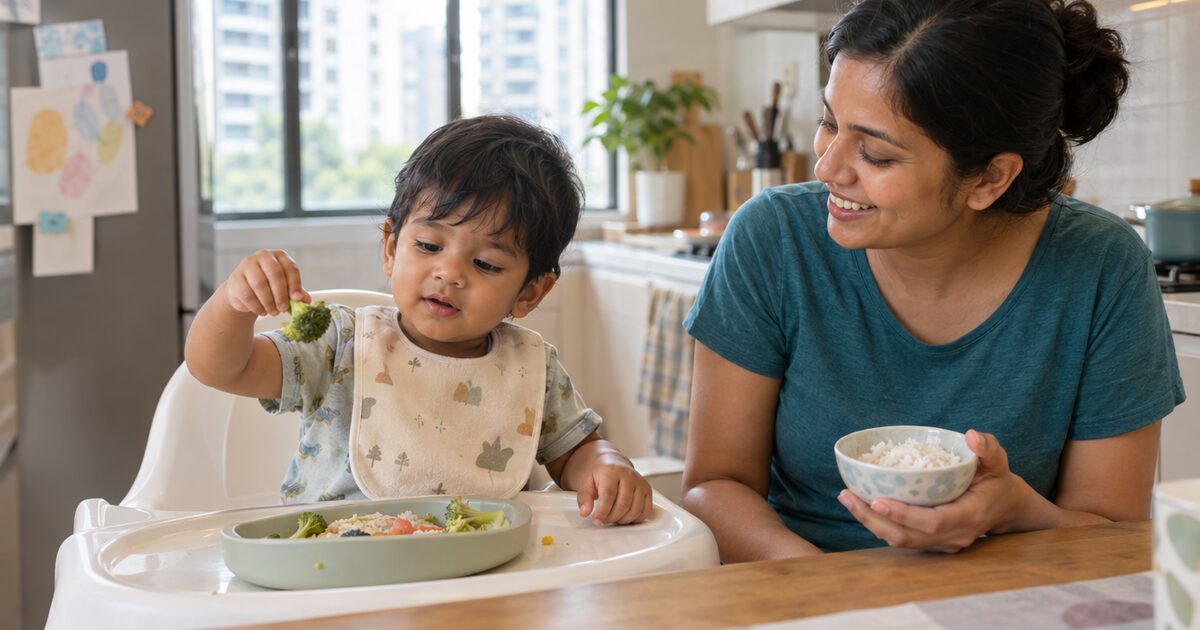
A toddler throwing food is often full, done with that food, or watching to see what you'll do. Climbing comes from the same urge to explore, and HealthHub says children from 12 to 24 months love to climb. Neither urge switches off, but you can serve less, end the meal calmly once the throwing starts, and make the high places in your flat safe.
What to do when your toddler throws food or climbs, step by step
- Serve a small portion and add more when your child asks. KKH says a usual portion for a 1 to 2 year old is a fifth to a quarter of an adult meal.
- Keep milk and snacks away for two hours before a meal, as KKH advises, so your child comes to the table hungry.
- Strap your child into the high chair and eat together. KKH asks parents to keep young kids strapped in, and HealthHub says children may be more open to eating when the family eats the same food.
- Put a small bowl beside the plate for food your child doesn't want. Say, "Don't want it? Put it here." NUH's feeding team says you decide what's served and your child decides how much.
- Answer the first throw with one calm line: "Food stays on the table." CDC advises giving less attention to behaviour you don't want to see, so keep your voice even.
- End the meal if the throwing carries on: "You're all done. Let's wash hands." HealthHub says to keep meals to 30 minutes, clear the food without anger, and skip milk or a favourite snack straight after.
- Give throwing a better place to go. Roll a ball back and forth after the meal, one of CDC's play ideas at 18 months.
- Lock every window grille and keep the keys out of reach. In KKH's 2012 to 2023 records, 51% of children's falls from buildings were from windows, and 89% of those happened at home.
- Move chairs, sofas and shelves away from windows, and fix cabinets and wardrobes to the wall, as HealthHub advises.
- Take your climber somewhere built for climbing, like a playground with equipment for their age. Stay close, and teach them to hold on with both hands, as HealthHub suggests.
Why toddlers throw food
CDC puts it plainly: learning to eat and drink is messy. NUH's feeding team tells parents to allow some food mess on the child, the table and the floor. It also suggests letting your child feed themselves for part of the meal while you feed the rest.
When food flies, look at what came just before. A few bites, then a throw? Your child may be full, and the food is now a toy. If one food gets thrown and the rest gets eaten, they don't want that one. That fits the age: KKH says turning down new and unfamiliar foods peaks between 18 and 36 months, as children start to show their independence. And a throw followed by a long stare at your face is a test. What will the grown-up do?
Calm doesn't mean anything goes. NUH says to be firm about what you won't accept when a child throws food. Firm can be quiet: the same short line each time, then the meal ends. If refusing food is the bigger worry, our fussy eater guide covers new foods and picky phases.
Why toddlers climb everything
Climbing is part of how toddlers learn to move. CDC lists climbing on and off a couch or chair without help as a milestone by 18 months. HealthHub says that from 12 to 24 months, children start to explore places that used to be out of reach. You can check other movement milestones in our baby milestone tracker.
The skill arrives before the judgement. HealthHub says preschoolers fall more because of curiosity, lack of judgement and motor skills that are still developing. So plan for two things: safe places to climb, and nothing risky within reach. Our toddler exercise guide has active play ideas for a small flat.
Throwing and climbing at a glance
| What you see | What it may mean | What to do |
|---|---|---|
| Throws after a few bites | Full or bored | End the meal calmly |
| Throws one food, eats the rest | Doesn't want that food | Point to the side bowl |
| Throws, then watches your face | Testing your reaction | One calm line, then carry on eating |
| Throws as soon as food arrives | Not hungry yet | Leave a longer gap after milk and snacks |
| Climbs the sofa by the window | Wants to see outside | Move the sofa and lock the grilles |
| Pulls up on drawers or shelves | Reaching for something up high | Fix the unit to the wall |
| Climbs anything, all day | Practising a new skill | Playground time, with you close by |
Keeping a climber safe in an HDB flat
High-rise living raises the stakes on climbing. HealthHub advises sturdy, locked grilles on the windows of high-rise flats, with the keys out of your child's reach. It also says window guards or stops are needed so your child can't open the windows. KKH adds that gates and grilles should be locked at all times.
Next, walk the flat. What sits near each window? A bed, the sofa, a dining chair and the laundry rack all count, and HealthHub says not to arrange furniture in a way that helps a child climb higher. HealthHub also says not to let children play along high-rise corridors, because there are no safety grilles there. Our baby-proofing checklist covers TVs, cords and every other room.
Helpers, grandparents and preschool: one set of rules
A rule works when every adult uses it. CDC's advice is to stay consistent as much as possible. HealthHub says to make sure anyone else caring for your child follows your instructions as closely as possible.
Agree three things with your helper, your parents or your in-laws: where meals happen, the words everyone says, and when the meal ends. HealthHub says your child should be seated, not running around, and eat in the same place where possible. If your child is used to eating while walking around the flat or the void deck, start with one seated meal a day.
Write the lines down so nobody has to remember them: "Food stays on the table." "Feet on the floor." "All done? Let's wash hands." Ask your child's preschool teachers what they say at meals, and borrow it. If a new helper is joining you, add the plan to our new helper arrival checklist. For calm limits beyond the table, see how to discipline a toddler without shouting. If ending a meal sets off a meltdown, our tantrum guide covers what to do in the moment.
When to get help
Talk to your GP, polyclinic doctor or paediatrician if you notice any of the signs below. The first one is different: it means going straight to the emergency department.
- A fall followed by unusual sleepiness, being hard to wake, vomiting that won't stop, or an unsteady walk. KKH lists these among the signs to go to the emergency department straight away after a head injury. Our toddler head injury guide covers the rest.
- You're worried about your child's growth, or mealtimes are causing you stress. NUH's feeding team lists both as reasons to see a doctor.
- Your child chokes, coughs or vomits during meals, or seems to be in pain while eating, which NUH also lists.
- Your child has trouble moving on to new food textures, another reason NUH gives.
- Fussy eating worries you every day for two weeks or more. KKH says that's the point to get medical advice.
- Your child isn't meeting milestones or has lost skills they once had. CDC says to act early and talk to the doctor.
KKH says community health professionals, like your GP or polyclinic team, can assess a child whose fussy eating persists and refer them to a paediatrician. To find one near you, try our paediatrician map.
Frequently asked questions
Why is my toddler throwing food on the floor?
Look for one of three reasons: your child is full, doesn't want that food, or likes the reaction a throw gets. NUH's feeding team says to allow some food mess, floor included, and suggests newspaper under the high chair. Watch what happens just before the throw, then use the table above to pick your response.
Should I give my toddler a timeout for throwing food?
HealthHub says a timeout of 1 to 2 minutes, or until your child calms down, can show that throwing food isn't accepted. Afterwards, explain calmly why and give a hug. With a young toddler, start simpler: end the meal without fuss.
Is my toddler climbing furniture normal?
Yes. CDC lists climbing on and off a couch or chair without help as a milestone by 18 months, and HealthHub says children love to climb from 12 to 24 months. Normal still needs a safe setup, so fix cabinets and wardrobes to the wall and keep furniture away from windows.
How do I stop my toddler climbing furniture?
Steer the urge instead of fighting it. HealthHub says to teach your child not to climb on furniture, and not to let them jump on beds or sofas. So lift them down each time with the same words: "Feet on the floor." Then take the climbing somewhere it belongs. Our playground list and indoor play areas guide cover dry days and wet ones.
Should I let my toddler feed themselves if it means more mess?
Yes, for at least part of the meal. NUH suggests your child feeds themselves some of it while you feed the rest, and KKH suggests a spoon with food already scooped on. A mat or newspaper under the high chair makes the clean-up shorter.
How long should a toddler meal last?
HealthHub says to limit meals to 30 minutes, and NUH's feeding team puts the limit at 30 to 45 minutes. After that, clear the food calmly and wait for the next meal or snack. HealthHub suggests 2 to 3 hours between meals and snacks.
- HealthHub, The dinner table is a battlefield. What can I do? (read 6 Nov 2026)
- HealthHub, Keeping your child safe (read 6 Nov 2026)
- HealthHub, Prevent falls and keep your child injury-free (read 6 Nov 2026)
- KKH, How parents can help children overcome fussy eating (read 6 Nov 2026)
- KKH, Child injury surveillance report 2024 (read 6 Nov 2026)
- KKH, Head injury (child) (read 6 Nov 2026)
- NUH Khoo Teck Puat - National University Children's Medical Institute, Picky eating (read 6 Nov 2026)
- CDC, Milestones by 18 months (read 6 Nov 2026)
ADHD in children in Singapore: early signs, assessment and support
ADHD in children in Singapore: how it differs from a lively preschooler, when doctors assess it, the polyclinic route an...
9 min read
Asthma in children in Singapore: signs, inhalers and what to do in an attack
Asthma in children in Singapore: the signs, reliever and preventer inhalers, using a spacer, the action plan, and when t...
8 min read
Balanced diet for toddlers in Singapore: plates, servings, sugar, tea and salt
A balanced diet for toddlers in Singapore: HPB's plate, daily servings for ages 1 to 6, hawker picks, and the advice on ...
9 min read