

Toys for speech development: the best toy types for each language stage, and when to get help in Singapore
In this article
The best toys for speech development are simple ones that get you talking together: board books and peekaboo for babies, animal figures, cars and stacking cups once first words appear, then pretend kitchens, dolls and puppets as sentences start. The toy matters less than the talk around it. KKH's speech therapists suggest making the sounds a toy makes and describing it as your child plays, such as "big red car". Below is a table pairing toy types with each language stage, how to play with them, and the Singapore route to a doctor or speech therapist if your child isn't talking by 18 months.
Toys matched to each language stage
The milestones come from KKH's speech therapists, HealthHub and KKH's Department of Child Development. Children vary, so treat the ages as a guide.
| Age | What talking usually looks like | Toys that help | Words to model while you play |
|---|---|---|---|
| 6 to 12 months | Babbling and baby talk; HealthHub says see a doctor if there's none by 12 months | Board books with faces and animals, a cloth for peekaboo, large toys with smooth handles, stacking cups in the bath | Peekaboo, uh-oh, bye-bye, splash |
| 12 to 18 months | First words; by 18 months about 10 words and the first two-word joins, such as "more milk" | Animal figures, toy cars and a ball, a shape sorter, push-along toys | Moo, vroom, go, stop, in, out, more |
| 18 months to 2 years | Two-word phrases; HealthXchange says children learning one language have over 200 words by 2 | A toy kitchen and play food, a baby doll, a toy phone, lift-the-flap books | Eat, hot, baby sleep, hello, where's ball? |
| 2 to 3 years | Short phrases and many new words a week; by 3 you should understand about 75% of what they say | Dress-up clothes, a pretend shop, puppets, picture puzzles | Big red car, my turn, open the door |
| 3 to 4 years | Sentences of three to four words by 3 and a half | Toy figures for making up stories, simple turn-taking games, play dough | First, then, because, what happened next? |
Under 3, check every toy for small parts. HealthHub suggests only larger toys with smooth, curved handles for babies who grab everything, and letter magnets, play dough and balloons need a watchful adult. Our toy safety guide covers age labels and choking checks, and toys and games by age has more play ideas.
How to play so the toy does its job
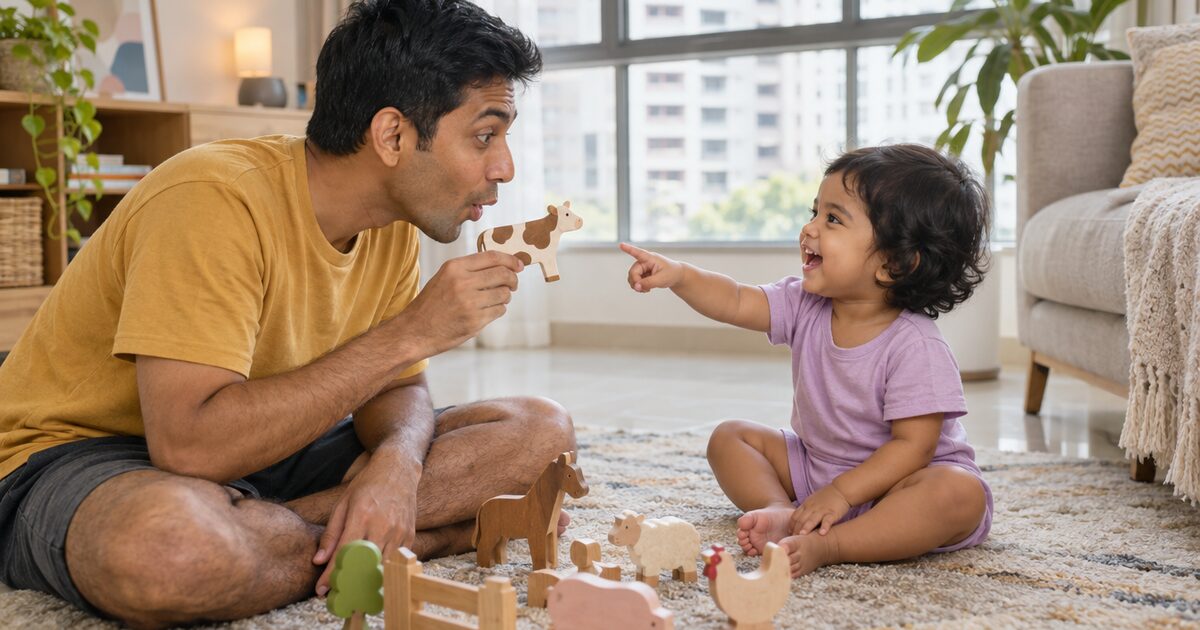
A toy with lots of buttons can do all the talking, so choose ones that need you. KKH's Department of Child Development suggests two easy habits: make the sounds that go with a toy, like b-b-b for bubbles or rrr for a car, and get your child to describe what they're playing with. These habits help too:
- Get down to your child's level and talk about what they're looking at, not what you want them to look at.
- Pause and wait. Leave a few seconds after "Ready, steady..." before "go" so your child can fill the gap.
- Add one word. If your child says "car", say "blue car" or "car go".
- Don't drill. KKH's speech therapist advises against asking your child to repeat a word several times, because it can give them a negative feeling about that word; just say it correctly back to them.
- Use the language you speak most comfortably at home.
- Read the same books again and again. Repetition is how toddlers learn words, and a library card costs nothing; see our guide to children's libraries.
Screens and talking toys
MOH's 2025 guidance on screen use, shared on HealthHub, says no screens under 18 months except video calls, no TV on in the background, and less than 1 hour a day outside school from 18 months to 6 years. HealthHub explains that background TV cuts the amount and quality of attention children get, which can delay language. Apps and videos that promise to teach words don't replace a person talking back. Our screen time guide has ways to keep within the limits.
When to see a doctor or speech therapist
Don't wait to see whether your child grows out of it. KKH's head speech therapist strongly recommends a consultation if a child has no first words by 18 months, because that can be the first sign of a language delay. See a doctor if your child:
- Isn't babbling or making baby talk by 12 months (HealthHub)
- Has no single words by 18 months (KKH)
- Doesn't follow simple instructions such as "bring your cup" by 18 months; HealthHub says to have their hearing checked as soon as possible if you think they can't hear you
- Isn't joining 3 or 4 words into phrases by 42 months (KKH)
- Is still hard to understand at 3 and a half, or stutters for more than 6 months after it started (KKH)
Getting help in Singapore
- Check the developmental milestones in your child's Health Booklet, which ECDA suggests as a reference point.
- Book a developmental screening at a polyclinic or a CHAS GP.
- If there are concerns, they refer you to the Child Development Programme at KKH's Department of Child Development or NUH's Child Development Unit, where paediatricians do a full evaluation at the first visit.
- KKH's speech therapy is by referral: your doctor decides whether speech therapy is needed and refers you on. KKH also runs regular training for parents who want to learn how to build their child's language at its Rehabilitation Centre.
Private speech therapists take direct bookings; ask about their qualifications and fees before the first session. Our baby milestones guide and milestone tracker help you note what your child is doing to show the doctor.
Frequently asked questions
What toys help with speech development?
Simple toys you play with together: board books, animal figures, toy cars, stacking cups, a play kitchen, dolls and puppets. KKH's therapists suggest making the toy's sounds and describing it as your child plays.
Are electronic talking toys good for speech?
They can do the talking for your child. Toys that need you, such as books, figures and pretend play, give your child more turns to talk.
How many words should a 2-year-old say?
HealthXchange says children learning one language have over 200 words by 2. If your child is learning two, tell the doctor the words they use in each language.
When should I worry about my toddler's speech?
If there are no single words by 18 months, KKH strongly recommends seeing a doctor. Also see one if there's no babbling by 12 months or no 3- to 4-word phrases by 42 months.
How do I get speech therapy in Singapore?
Start with a developmental screening at a polyclinic or CHAS GP. They can refer you to KKH or NUH's child development services; KKH's speech therapy needs a doctor's referral.
- HealthXchange (KKH) - Is my child a late talker? (read 12 October 2026)
- HealthXchange (KKH) - Speech and language milestones in children (read 12 October 2026)
- HealthHub - The beginner's guide to taking care of your baby: 13 to 18 months (read 12 October 2026)
- HealthHub - The beginner's guide to taking care of your baby: 7 to 12 months (read 12 October 2026)
- HealthHub Parent Hub - Screen use, 0 to 2 years, MOH guidance 2025 (read 12 October 2026)
- KKH Department of Child Development - Language milestones and activities (PDF) (read 12 October 2026)
- KKH - Department of Child Development (read 12 October 2026)
- KKH - Speech language therapy (read 12 October 2026)
- Ask.gov.sg (ECDA) - Developmental delays: screening at polyclinics and CHAS GPs (read 12 October 2026)
- Ask.gov.sg (MSF) - Child Development Programme referrals (read 12 October 2026)
Best preschools in Singapore: how to choose a preschool by fees, hours, quality and curriculum
How to choose the best preschool in Singapore: ECDA fees for 1,795 preschools by operator type, hours and SPARK status, ...
14 min read
Bullying in preschool: the warning signs, what to say to your child, and how to escalate with a Singapore childcare centre
Bullying in preschool: how to tell it from rough play, the warning signs, what to say to your child, and the steps to es...
6 min read
Childcare centres in Singapore: infant care, anchor vs partner operators, subsidies and choosing one
How childcare centres in Singapore work: anchor vs partner operator fee caps, infant care, subsidies, waitlists and what...
11 min read