

Best toys for babies by age: what to choose from birth to 3
In this article
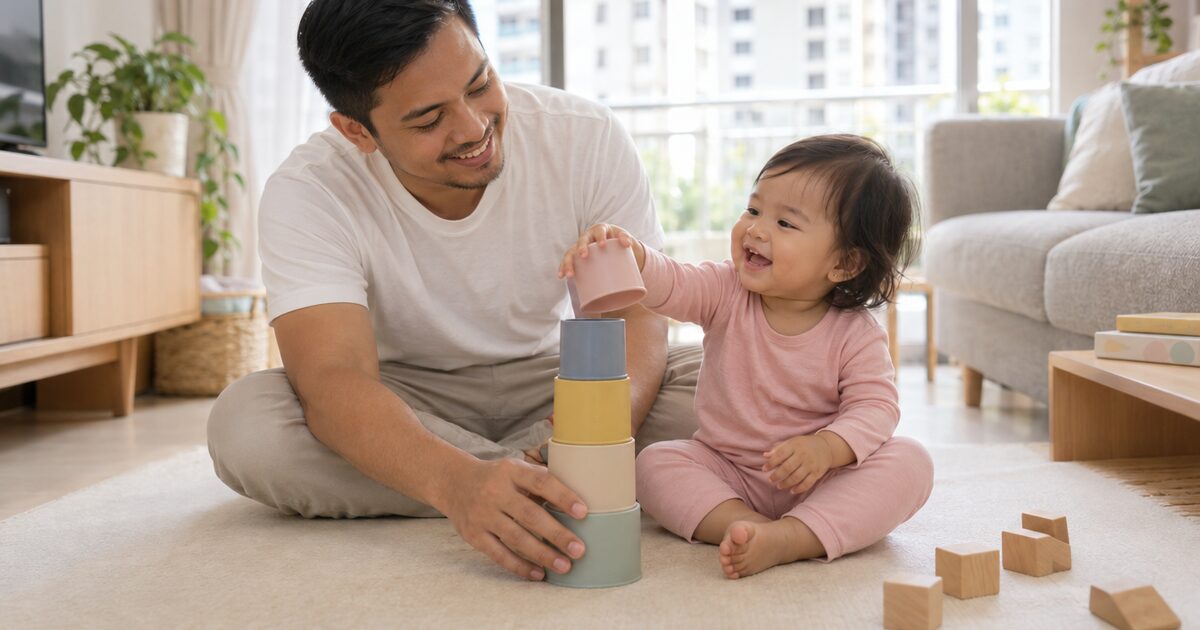
The best toys for babies by age are simple ones that fit what your child is learning right now. At 6 months that's grasping and shaking, so a rattle works. At 1 year it's putting a block in a cup, so stacking cups and blocks work. At 2, make-believe starts, and a toy kitchen or a doll fits. Then check the age label and play along.
How to choose toys by age, step by step
- Watch what your child does this month. KKH's development guide lists skills by age, and our milestone tracker keeps notes for you.
- Pick a toy that practises that skill. KKH says a 6-month-old can grasp a rattle and shake it, and a 1-year-old puts a block in a cup.
- Read the age label and follow it. CPSO says not to buy a toy that comes without age and use information.
- Check every toy for parts that could fit in a child's mouth, nose or ear, which CPSO says to avoid. Battery compartments should be properly secured.
- Choose a plain toy over a flashy one when you can. An SGH physiotherapist, writing for Families for Life, says a toy doesn't need to be fanciful or expensive.
- Skip the seated baby walker, since KKH says walkers don't help babies walk earlier. It suggests floor space and a play-centre that stays still instead.
- Keep screens out of the toy box. MOH's 2025 guidance, on HealthHub, says no screen use under 18 months, except video calls.
- Put out a few toys at a time. Families for Life suggests rotating them every few days so they feel new.
- Get on the floor and play too. HealthHub suggests naming what your toddler sees and describing its shape, colour and use.
Toys that fit each stage, birth to 3
The skills below come from KKH's development guide and HealthHub's toddler guides. The toy types are ours, chosen to practise each skill. KKH notes that babies develop at their own pace, so go by what your child does this month.
| Age | What your child is learning | Toy types that fit |
|---|---|---|
| Birth to 6 months | Follows a slowly moving object with the eyes at 1 month; grasps a rattle and shakes it by 6 months (KKH) | Your face and voice, a light rattle, soft toys with different textures |
| 6 to 12 months | Passes things from hand to hand; drops and throws toys to watch them fall at 9 months; puts a block in a cup at 12 months (KKH) | Stacking cups, large blocks, soft balls, board books |
| 12 to 18 months | Walks alone by 18 months; flips book pages and pushes a toy car (HealthHub) | A shape sorter, 2.5 cm blocks, a toy car to push, board books |
| 18 to 24 months | Pretend play, such as cooking with toy utensils; practising a tower of up to 4 blocks (HealthHub) | Puzzles of 4 to 12 pieces, snap-together blocks, a toy kitchen set, crayons, chalk, balls |
| 2 to 3 years | A tower of six cubes, scribbles alone, begins make-believe play (KKH) | Building sets, dolls and dress-up, picture books, sturdy toys that don't break easily |
For first-year games and tummy time, see newborn toys and games by age. For toys that get your child talking, see toys for speech development.
Why simple toys teach more than educational ones
A toy sold as educational can tempt you to buy ahead of your child's age. CPSO cites a KKH study in which parents bought toys they believed would help their child learn, and thought the child was old enough to use them safely. Toy-related injuries in children under 5 rose 15% in 2013 compared with 2012.
A plain toy leaves more for your child to do. The SGH physiotherapist says a simple toy lets a child use their senses and their imagination. A set of cups can be stacked, nested, filled in the bath or banged like a drum. A toy that lights up at one button press does one thing.
HealthHub adds that toddlers aged 19 to 24 months have good control of their fingers and like to handle small objects. So the label matters even more once your child can pick things up. Our guide to boosting brain development covers what helps learning beyond toys.
Baby walkers, push toys and screens
A seated baby walker looks like a toy that teaches walking. KKH says it doesn't, and may delay it. Babies in most walkers can't see their feet, and KKH cites studies where babies who spent 2 hours a day in one learned to walk later. A walker can also reach 1 metre per second, fast enough to get to the stairs or a hot pot before you can catch up.
KKH suggests safe floor space and supported standing instead. A playpen or play-centre that doesn't move is fine too. KKH says most babies cruise from 8 to 12 months and walk from 10 to 15 months. Once your toddler walks, a toy car to push fits HealthHub's 13 to 18 months stage. CPSO says riding toys should be stable and not topple easily.
For screens, follow MOH's 2025 guidance on HealthHub. Under 18 months, no screen use except video calls, and no TV on in the background. From 18 months to 6 years, less than 1 hour a day outside school. It also says not to use a screen just to keep your child busy. Our screen time guide has house rules that make this easier.
How many toys, and what they cost
Fewer than you'd think. Families for Life suggests taking out only a few toys at a time and rotating them every few days. Let your child finish with one toy before you add another, it says. In an HDB flat, that also means a smaller box to tidy.
You don't have to buy every stage new. A toy library lends them, and our guide to preloved baby items covers buying second-hand. Check second-hand toys for cracks and loose parts before they go in the box, as CPSO advises for every toy. Our guide to where to buy toys in Singapore lists shops, and gift ideas for kids helps when family ask what to get.
On the product pages of four sellers we read on 7 Nov 2026, the five toys we priced had listed prices of $2.90 to $19.90. Stacking cups were the cheapest, at $2.90 to $6.90. Prices sellers publish, in alphabetical order:
| Seller | What the listing is | Listed price |
|---|---|---|
| IKEA | UPPSTA building beakers, 7 stacking cups, from 6 months | $2.90 |
| IKEA | UNDERHALLA wooden block set, 40 pieces, from 18 months | $19.90 |
| Kiddy Palace | Hap-P-Kid playhouse shape sorter, from 12 months | $13.30 |
| Mothercare | Little Lot rainbow stacking cups, 10 cups and a topper, from 6 months | $6.90 |
| Toys"R"Us | Crayola large washable crayons, pack of 16, 3 years and up | $12.49 |
Look at the crayon label. The pack we priced is for 3 years and up, while HealthHub lists crayons for 19 to 24 months. For a younger toddler, find a pack whose label fits their age.
Toy safety in brief
CPSO's toy tips come down to a few checks. Buy for your child's age, and keep older siblings' toys out of reach. Skip toys with long cords, sharp edges, very loud sounds or small parts with strong magnets. Check toys often for breaks and loose parts, and take batteries out of electronic toys you aren't using. CPSO adds that magnetic balls and water beads can't be sold as toys for children under 14.
Soft toys can come out to play, but keep them out of the cot; our safe sleep guide explains why. Our toy safety guide covers age labels, the choking check and recalls in full.
When to get help
- Your child may have swallowed a battery, a magnet or part of a toy. CPSO says get medical help straight away. Go to the nearest children's emergency department, or call 995 in an emergency, as KKH advises.
- At 18 months your toddler can't walk alone, has no meaningful words, or doesn't know their caregivers. HealthHub says to act early and see a doctor.
- Your child walks on tiptoe or on the sides of the feet. See your doctor, KKH says.
- A toy looks unsafe. Call CPSO on 1800 325 8282, or use its contact page.
- You're not sure whether a toy has been recalled. Check CPSO's alerts and recalls for children's products, as CPSO's toy tips ask.
Frequently asked questions
What are the best toys for babies?
Simple ones that fit your baby's stage. A rattle, stacking cups, blocks and board books cover most of the first year. KKH's development guide shows what your baby can do at each age, so you can match the toy to the skill. Follow the age label on every toy, as CPSO advises.
What toys are good for a 6 month old?
KKH says a 6-month-old can grasp a rattle and shake it. Everything goes into the mouth at this age, so size matters. A light rattle and soft toys with different textures fit that stage. Stacking cups labelled from 6 months work too, and they listed at $2.90 to $6.90 on 7 Nov 2026.
What are good toys for a 1 year old in Singapore?
HealthHub's 13 to 18 months guide suggests 2.5 cm wooden or plastic blocks to bang and stack, and a shape sorter. A toy car to push fits too, since HealthHub says toddlers this age push toy cars and flip book pages. On 7 Nov 2026, Kiddy Palace listed a shape sorter labelled from 12 months at $13.30.
What toys are good for a 2 year old?
HealthHub's 19 to 24 months guide lists puzzles of 4 to 12 pieces, blocks that snap together, pretend-play sets, crayons, chalk and balls to kick and throw. KKH adds that 2-year-olds can get rough with toys, so pick sturdy ones that don't break easily.
Are educational toys for babies worth buying?
Not for the label alone. The SGH physiotherapist says toys don't need to be fanciful or expensive. And the KKH study CPSO cites found parents buying toys for their learning value before their child was old enough to use them safely. A plain toy you play with together does the teaching.
Is a baby walker a good toy?
KKH says no. Seated walkers don't help babies walk earlier and may delay walking. They can also move at 1 metre per second. Use floor space and a play-centre that stays still instead.
- KK Women's and Children's Hospital (KKH), Development: growing up (read 7 Nov 2026)
- KK Women's and Children's Hospital (KKH), Walking: growing up (read 7 Nov 2026)
- HealthHub, The Beginner's Guide To Taking Care of Your Toddler: 13 to 18 Months (read 7 Nov 2026)
- HealthHub (Health Promotion Board), The Beginner's Guide To Taking Care of Your Toddler: 19 to 24 Months (read 7 Nov 2026)
- HealthHub Parent Hub, 0-2 Years Screen Time, citing MOH Guidance on Screen Use in Children 2025 (read 7 Nov 2026)
- Consumer Product Safety Office (CPSO), Safety Tips on Children Toys (read 7 Nov 2026)
- Consumer Product Safety Office (CPSO), Contact Us (read 7 Nov 2026)
- Families for Life, Choosing the Right Toys for Your Child: Young Children (contributed by HealthXchange, quoting an SGH physiotherapist) (read 7 Nov 2026)
- KK Women's and Children's Hospital (KKH), Emergency: childhood illnesses (read 7 Nov 2026)
- IKEA Singapore, product page: UPPSTA building beakers (read 7 Nov 2026)
- IKEA Singapore, product page: UNDERHALLA 40-piece wooden building block set (read 7 Nov 2026)
- Kiddy Palace, product page: Hap-P-Kid Little Learner Playhouse Shape Sorter (read 7 Nov 2026)
- Mothercare Singapore, product page: Little Lot Rainbow Stacking Cups (read 7 Nov 2026)
- Toys"R"Us Singapore, product page: Crayola 16 Ct Large Washable Crayons (read 7 Nov 2026)
Air purifier for baby: when it helps and what to check
Do babies need an air purifier? What NEA and HealthHub say on HEPA, CADR for an HDB bedroom and ozone, plus seller price...
6 min read
Art Jamming in Singapore: A Family Guide to Painting and Art Fun
Your parent's guide to art jamming in Singapore: what it is, the best ages, studio vs cafe vs at-home, what to bring, ro...
11 min read
Baby Fairs in Singapore: A Parent's Guide to Deals, Dates and Smart Shopping
A practical guide to baby fairs in Singapore: where they run, what to buy and skip, how to spot real deals, what to brin...
10 min read