

STEM classes for kids in Singapore: ages, prices and what school covers
In this article
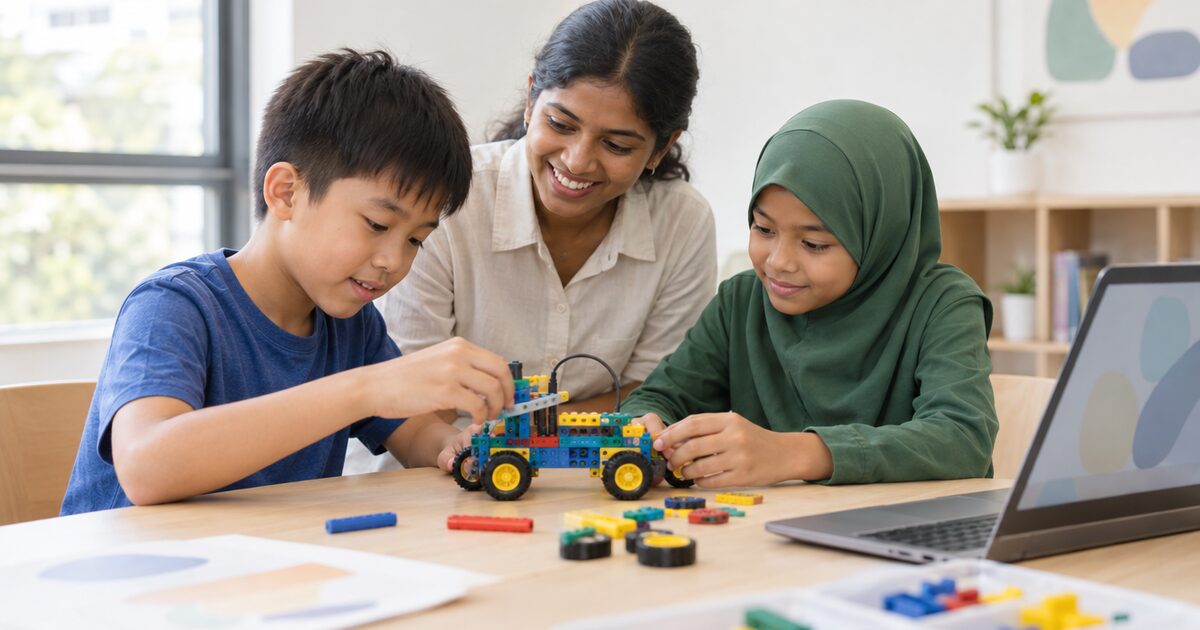
STEM classes for kids in Singapore mostly mean robotics and hands-on science, with some maths and engineering mixed in. The right class gives your child real hands-on time, in a small group, at a level that suits their age. On the fee pages we read on 6 Nov 2026, community club courses worked out to about $17 to $20 an hour and private centres to about $41 to $63. Before you pay for a term, see what school and the Science Centre already give you, because some of it costs nothing.
How to choose a STEM class, step by step
- Check what school already covers: MOE teaches science as a subject from Primary 3 to Primary 6, and a school's SchoolFinder page lists its Applied Learning Programme and its CCAs.
- Follow your child's interest. If they take toys apart, try robotics; if they keep asking why things float, try a science class. Screen-based coding has its own guide to coding classes for kids, and maths has one on math enrichment.
- Choose building and play over a tablet for a preschooler, since MOE's preschool framework says children aged four to six learn by experimenting and experiencing.
- Try the free and cheap options first: Science Centre Singapore lets Singaporean and PR children aged 3 to 12 in free on off-peak weekdays, and community club robotics courses on onePA cost $110 to $120 for four sessions.
- Ask how many children share one teacher and one kit; the onePA listings we read capped classes at 8 to 15 children.
- Book a trial and count how long your child spends building and testing, against how long they sit and listen.
- Read the refund and make-up rules before you pay. The onePA robotics course we read gives no refund once paid, and a lesson your child misses isn't replaced.
- Check that the centre is registered with MOE, which says a private school teaching 10 or more people must register. MOE adds that registration doesn't vouch for quality.
- Put the term fee into our enrichment budget planner to see what a whole year costs before you sign.
What school and preschool already teach
Science becomes a school subject in Primary 3. MOE's current syllabus started with the 2023 Primary 3 cohort and runs to Primary 6. One of its aims is to build on children's interest and stir their curiosity about themselves and their environment. In Primary 5 and 6, MOE offers science at foundation or standard level, based on Primary 4 exam results.
Schools also run an Applied Learning Programme, or ALP. MOE says it's non-examinable and centred on applying what children learn in real-world settings. Its page for secondary schools lists STEM as one area a school may choose. A primary school's SchoolFinder page names its ALP, such as digital making, and its CCAs, which can include robotics. MOE strongly encourages a CCA at primary level.
Before Primary 1, MOE's Nurturing Early Learners framework shapes preschool lessons for children aged four to six. One of its learning areas, Discovery of the World, helps children make sense of their surroundings, and MOE says it lays the foundation for science later on. A preschool that follows it is already doing early STEM. If you're getting ready for P1, our guide on how to prepare your child for Primary 1 covers the rest.
What each age is ready for
The ages here come from MOE, KKH, Science Centre Singapore and the providers' own class pages. Treat them as a starting point.
| Age | What fits | Where to start |
|---|---|---|
| 2 to 3 | Short sessions with water and sand, and you right beside them. KKH says under 1 hour of screen time a day from 18 months. | ToTally Science at KidsSTOP, for ages 2 to 3: $65, or $60 for members |
| 4 to 6 | Building with bricks and sink-or-float tests. KKH says recreational screen time should stay under 1 hour a day. | KidsSTOP, for ages 8 and under: $5 off-peak for residents. LEGO classes start at 4 or 5. |
| 7 to 9 (P1 to P3) | Small robots with motors and sensors, and simple experiments. School science starts in P3. | Community club robotics courses for ages 6 to 12 |
| 10 to 12 (P4 to P6) | Bigger robot kits, electronics and team challenges | A school robotics CCA, if offered, or a centre class using kits such as SPIKE Prime |
Readiness matters more than the birthday. If your child can follow a few steps and sit through the session, they're ready to try. For preschoolers, KKH's guidelines ask for at least 180 minutes of physical activity a day, so pair a seated class with plenty of active play. If you're weighing STEM against other activities, our enrichment classes guide helps you plan the week.
Free and low-cost STEM in Singapore
Start at Science Centre Singapore. Its ticket page, read on 6 Nov 2026, lets Singaporean and PR children aged 3 to 12 in free on weekdays outside school and public holidays, and charges them $4 at peak times. KidsSTOP is its gallery for children aged 8 and below, with hands-on STEM exhibits, and a resident child aged 18 months to 8 years pays $10 at peak and $5 off-peak. Our Science Centre and KidsSTOP guide covers sessions and passes.
Community clubs list their courses on onePA. On 6 Nov 2026 we found a robotics course for ages 6 to 12 at $110 to $120 for four weekly 90-minute sessions, and a 2.5-hour December science workshop at $42 to $47, plus an $8 material fee.
At home, our easy science experiments need only kitchen items. NLB's MakeIT makerspaces run free robotics workshops for members, but NLB sets them for ages 13 and above, so keep them for later. For younger children, our children's libraries guide covers NLB's own programmes.
What to look for in a class and a trial
- Ask whether each child builds, or whether most of the class watches the teacher. One holiday camp we read pairs children on a robot kit, which works if both get turns.
- Get the number of children per teacher. A centre that knows its ratio will tell you straight away.
- Find out what the teacher trained in and what they do when a child gets stuck.
- See what comes home, such as a photo of the build or a project to keep going with.
- Check whether kits and materials cost extra. Some centres include all equipment, while the onePA science workshop we read adds $8 for materials.
- Treat competitions as an extra. Science Centre's National Robotics Competition has a preschool category for ages 5 to 6, and primary categories for ages 7 to 12 in teams of 2 to 3 with a coach.
Prices providers publish, in alphabetical order
These are the prices on each provider's own page, read on 6 Nov 2026, listed in alphabetical order.
| Provider | Class, age and length | Published price |
|---|---|---|
| Atomic Concept (Lollipops Science), on onePA | December science workshop at a community club, one 2.5-hour session, age not listed | $42 to $47, plus $8 for materials |
| Computhink | LEGO robotics holiday camp, ages 7 to 12, 3 days of 3 hours | $367 |
| Duck Learning (STEAM Engine) | LEGO robotics holiday workshop, ages 4 to 8 or 9 and up, 4 sessions of 1.5 hours | $380 |
| Nullspace Robotics | STEM Little Explorer, ages 5 to 6, 10 weekly 1-hour sessions | $520 a term |
| Nullspace Robotics | STEM Explorer, ages 7 to 8, 10 weekly 2-hour sessions | $1,000 a term |
| Robotics Revolution, on onePA | Coding and robotics at a community club, ages 6 to 12, 4 weekly 1.5-hour sessions | $110 to $120 |
| STEM Genius | LEGO robotics trial, ages 5 and up, 60 or 90 minutes | $45 trial; term fees not published |
Per hour, the community club courses came to about $17 to $20 and the private centres about $41 to $63, before trials and material fees. Read the terms before you pay: Nullspace's packages, for example, can be transferred but not refunded.
When to get help
- School science or maths feels hard: talk to the form teacher first. MOE picks some pupils for its Learning Support for Mathematics programme, and our guide on whether tuition is necessary helps you weigh the next step.
- You're not sure a centre is registered: search MOE's list of registered private schools.
- A centre won't refund money it owes you: file a dispute with CASE online, or call 6277 5100.
- Your child dreads class or seems upset: pause the class and talk with them. Primary school children aged 13 and below can call Tinkle Friend on 1800 2744 788.
Frequently asked questions
How much do STEM classes cost in Singapore?
On providers' own pages we read on 6 Nov 2026, a community club robotics course cost $110 to $120 for four sessions, while private centres charged $367 to $380 for a holiday camp or workshop and $520 to $1,000 for a 10-session term. That's about $17 to $63 an hour.
What age can kids start robotics classes in Singapore?
The provider pages we read take children from 4 or 5 for LEGO-based classes, and the National Robotics Competition starts at ages 5 to 6. For a preschooler, choose a short class where they build with their hands rather than tap a tablet. KKH's guidelines keep recreational screen time under 1 hour a day for ages 3 to 6.
Is STEM enrichment for preschool worth paying for?
It can be, if your child loves building and the class is play-based. MOE's preschool framework already asks preschools to let children learn by experimenting, so the school day covers a lot. Try KidsSTOP and a few home experiments first, then pay for a term once the interest lasts.
Are there free science classes for kids in Singapore?
Few classes are free, but plenty of science is. Science Centre Singapore lets resident children aged 3 to 12 in free on off-peak weekdays, and NLB's MakeIT workshops are free for members aged 13 and up. For younger children, a community club science workshop on onePA cost $42 to $47 when we checked.
What do LEGO robotics classes in Singapore teach?
Your child builds a robot from LEGO parts, then codes its motors and sensors to do a task. Science Centre's competition lists SPIKE Essential and WeDo 2.0 kits for lower primary and SPIKE Prime for upper primary. Coding classes stay on screen, and our coding classes guide covers them.
- Ministry of Education, Science Teaching and Learning Syllabus, Primary Three to Six (read 6 Nov 2026)
- Ministry of Education, Nurturing Early Learners (NEL) Framework (read 6 Nov 2026)
- Ministry of Education, Applied Learning Programme (read 6 Nov 2026)
- Ministry of Education, Register a private school (read 6 Nov 2026)
- Science Centre Singapore, Ticket prices (read 6 Nov 2026)
- Science Centre Singapore, National Robotics Competition (read 6 Nov 2026)
- KKH, Singapore Integrated 24-Hour Activity Guidelines for Early Childhood (read 6 Nov 2026)
- People's Association, onePA courses (read 6 Nov 2026)

Art classes for kids in Singapore: what to choose at each age
Art classes for kids in Singapore, age by age: what school art covers, free gallery options, what to watch in a trial, a...
7 min read
Best preschools in Singapore: how to choose a preschool by fees, hours, quality and curriculum
How to choose the best preschool in Singapore: ECDA fees for 1,795 preschools by operator type, hours and SPARK status, ...
14 min read
Bullying in preschool: the warning signs, what to say to your child, and how to escalate with a Singapore childcare centre
Bullying in preschool: how to tell it from rough play, the warning signs, what to say to your child, and the steps to es...
6 min read