

Washing baby clothes: detergent, stains and drying in an HDB flat
In this article
Washing baby clothes is mostly ordinary laundry. You can put them in with the family's wash and use a mild detergent. Wash every new piece before your baby wears it, and treat milk and poo stains while they're fresh. If your baby's skin reacts, switch to a fragrance-free detergent.
How to wash baby clothes, step by step
- Wash every new piece before your baby wears it. The Consumer Product Safety Office (CPSO) says in its tips on children's clothes that new textiles can carry substances such as formaldehyde, and washing removes many of them.
- Wash gifts and hand-me-downs too. The American Academy of Pediatrics (AAP) advises washing all clothes first, since you can't know who handled them before they reached you. Our guide to preloved baby items covers what else to check.
- Read the care label as you sort. The AAP points you to the label for washing instructions. CPSO asks you to check for loose buttons and small parts, which can be a choking risk.
- Start with a mild detergent and the family's load. The AAP says many parents wash baby clothes with everyone else's without any problems.
- Rinse or wipe off milk, spit-up and poo while the stain is fresh. If you can't wash it yet, soak the piece in water and detergent until you can, as the AAP suggests.
- Put socks and mittens in a mesh bag. Fasten the Velcro tabs on bibs before they go in, so they don't snag other clothes (AAP).
- Run full loads where you can. PUB's water tips are to wash on a full load and choose the right cycle, and small baby items fill gaps in a family load.
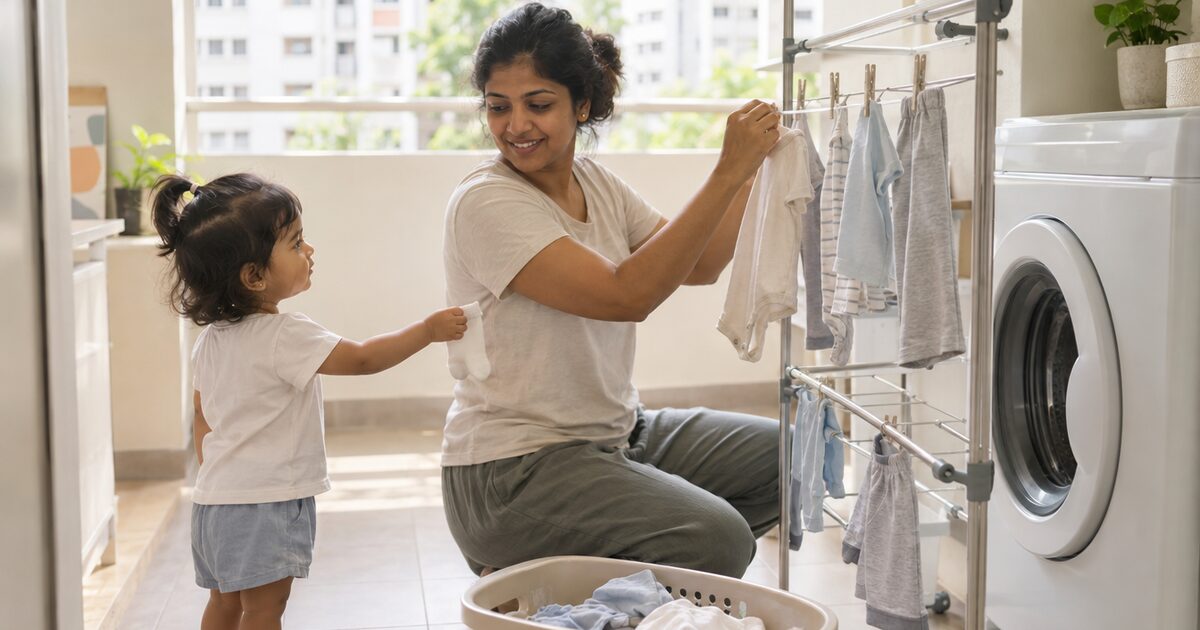
- Dry the wash on your flat's own rack or an indoor rack. HDB lists clothes racks on common-corridor parapet walls among its killer-litter don'ts.
- Keep detergent in its own bottle, in a cabinet your child can't reach. CPSO says to keep that cabinet locked at all times and never repack chemicals into other containers.
Which baby laundry detergent to use
You don't need a special baby detergent to start. The AAP says to buy a milder baby detergent, or a hypoallergenic or fragrance-free one, if your baby shows signs of skin irritation. Until then, the family's usual detergent is fine.
Eczema changes that. HealthHub lists perfumes and detergents among the chemicals that can set off a flare. HealthHub puts eczema at about 20% of school children in Singapore. For a baby with eczema, a fragrance-free detergent is the first swap to try. Change one product at a time, so you can tell what helped.
Capsules and pods need the same care as bottles. CPSO's tips on household chemicals cover laundry detergents and fabric softeners. Bright packaging can look like food or drinks to a child, CPSO notes, so don't leave a pack out while you load the machine. Our baby proofing checklist covers the other cabinets in your flat.
For the skin side, from moisturiser to fabrics, see our baby eczema guide. Redness in the nappy area has its own page on diaper rash.
How to wash each item and stain
Most baby stains are milk, spit-up and poo. They lift more easily while they're fresh, which is why the AAP suggests keeping a spot for soaking soiled clothes.
| Item or stain | How to wash it | Why |
|---|---|---|
| New clothes and gifts | Wash once before the first wear | CPSO: washing removes many finishing substances, such as formaldehyde |
| Hand-me-downs | Wash before your baby wears them | AAP: you can't know who handled them before you |
| Milk, formula and spit-up | Wipe or rinse off while fresh, then soak in water and detergent | AAP: a fresh stain comes out more easily |
| Poo | Rinse off as much as you can, then soak until wash day | AAP: the same advice as milk stains |
| Socks and mittens | Wash and dry in a mesh bag | AAP: small items stay together |
| Bibs with Velcro | Fasten the tabs first | AAP: open tabs snag other clothes |
| Hoodies and tops with cords | Check the cords as you sort | CPSO: no cords or drawstrings at the hood and neck |
| Cloth nappies | Their own pre-wash and main wash | See our cloth diaper guide |
For bibs themselves, our guide to baby bibs covers what to look for when you buy them.
Choosing a washing machine for baby clothes
Your household machine is enough for baby clothes; you don't need a separate one. If you're buying a new washer or dryer, these are the things Singapore's agencies ask you to check.
| What to check | What it tells you |
|---|---|
| SAFETY Mark | CPSO asks you to look for it on washing machines. Check the model number or 8-digit registration number in its Register of Registered Controlled Goods. |
| PUB water label | PUB says to pick more ticks and the lowest water use per wash. The label shows water use, wash programme, type, brand and model. |
| Size | Buy one that fits your family's laundry, so you don't overload it (CPSO). PUB also says to choose a suitable capacity. |
| Installation | CPSO says qualified personnel should install a washer or dryer. |
| Dryer lint filter | Clean it before and after each load, and keep anything that burns away from the machine (CPSO). |
A child lock and an extra-rinse setting work differently on each model. CPSO says to read the instruction manual and follow its directions, so check there for what your machine has. When a machine shows signs of a fault, CPSO says to call the authorised servicing agent or supplier.
Setting up before the birth? The newborn shopping list covers the rest of what to buy.
Drying baby clothes in an HDB flat
If you dry laundry outside a window, HDB's killer-litter rules apply to it. HDB asks you not to criss-cross bamboo poles or lay items across them. Don't hang things such as shopping trolleys from the pole holders, either. Keep items away from open windows, ledges and aircon compressors.
If you leave an item in a hazardous spot after a written notice from HDB and you're convicted, the fine is up to $2,000.
Indoors, a free-standing rack by a window or under a fan works well. Let clothes dry fully before you fold them away, since damp fabric in a closed cupboard turns musty in our humidity. A tumble dryer helps in a wet week; clean its lint filter before and after each load, as CPSO advises.
On haze days, our haze guide covers NEA's PSI bands and what to do indoors.
How often to wash, and how many clothes that takes
How often you wash sets how many clothes you need. Our newborn clothes sizes guide has a starter set built around that. The baby clothing size calculator shows when your baby is likely to move up a size, so you don't wash a drawer of clothes that no longer fit. For layers in our heat, see how to dress a newborn in Singapore.
When to get help
- A rash that oozes fluid, forms yellow crusts or spots, or turns swollen or sore: see a doctor at a GP clinic or polyclinic. HealthHub lists these as reasons to go.
- Eczema that isn't better after 1 to 2 weeks of home care, or gets worse: HealthHub says to see a doctor. Flares that disturb your child's sleep are another reason.
- Your child swallows liquid detergent: seek emergency care straight away. HealthHub says to tell the doctor your child's age, weight, condition, what they may have swallowed and when.
- Signs of poisoning include vomiting, tremors, sweating, tummy pain, burns around the lips and mouth, and loss of consciousness (HealthHub). Don't give milk or make your child vomit unless a doctor tells you to.
- Your child is unconscious after swallowing something: call 995 for an ambulance (HealthHub).
- Detergent on the skin that leaves a chemical burn: flush the area with running water, as HealthHub advises.
- A washer or dryer showing signs of a fault: call the authorised servicing agent or supplier (CPSO).
Frequently asked questions
Do you need to wash new baby clothes before your baby wears them?
Yes. CPSO's tips say to wash all new clothes before wearing them. Textiles can carry substances such as formaldehyde, used to make fabric softer or wrinkle-free, and washing removes many of them. Do the same for gifts and hand-me-downs.
How do you wash newborn clothes?
Wash anything new once, then wash newborn clothes with the family's laundry in a mild detergent. Treat milk and poo stains while they're fresh and put socks in a mesh bag. If your newborn's skin gets irritated, switch to a milder or fragrance-free detergent, as the AAP suggests.
Which baby laundry detergent should I use in Singapore?
Start with a mild detergent; the AAP says a special baby one is worth buying only if your baby's skin gets irritated. For eczema-prone skin, try a fragrance-free product, since HealthHub lists detergents and perfumes among eczema triggers. Whichever you buy, store it in a locked cabinet, as CPSO advises.
Do I need a separate washing machine for baby clothes?
No. The AAP says many parents wash baby clothes with the family's laundry without problems. If you're buying a machine anyway, look for the SAFETY Mark, choose more ticks on PUB's water label, and pick a size that fits your household's laundry.
How do you remove poop stains from baby clothes?
Rinse or wipe off as much as you can while the stain is fresh. If you can't wash it straight away, soak the piece in water and detergent until you can, as the AAP suggests. Then wash it as usual and follow the care label.
Can I wash cloth nappies with baby clothes?
Cloth nappies follow their own routine, with a pre-wash and a longer main wash. Our cloth diaper guide covers it step by step, and drying them in our humidity too.
- CPSO, Safety Tips on Children's Apparel (read 7 Nov 2026)
- CPSO, Safety Tips on Washing Machines and Tumble Dryers (read 7 Nov 2026)
- CPSO, Safety Tips for Storing Household Chemicals (read 7 Nov 2026)
- HealthHub, Eczema (read 7 Nov 2026)
- HealthHub, Emergency Care (Children) (read 7 Nov 2026)
- HDB, Keeping Killer Litter Away (read 7 Nov 2026)
- PUB, Save More with Water Efficient Washing Machines, WELS brochure (read 7 Nov 2026)
- American Academy of Pediatrics (HealthyChildren.org), Cleaning Baby Clothes (read 7 Nov 2026)
Baby blocked nose: how to clear it, and which breathing sounds need a doctor
Baby blocked nose? Saline drops, then gentle suction, as KKH and NUH advise. Plus a table of noisy breathing sounds and ...
8 min read
Baby Choking First Aid: What Every Singapore Parent Should Know
Baby choking first aid in Singapore: spot true choking, do infant back blows and chest thrusts, know when to call 995, a...
11 min read
Baby colic, reflux and gripe water: what Singapore doctors advise and when to worry
Baby colic and reflux in Singapore: what KKH, NUH and HealthHub say about gripe water and gas drops, how to soothe cryin...
12 min read