

First year baby mistakes: 14 to avoid, and what Singapore doctors advise instead
In this article
You'll make plenty of small first year baby mistakes, and most of them sort themselves out. The few that matter for safety are about sleep, shaking, falls, water, the car seat and a fever before 3 months. Each one below comes with what to do instead and the Singapore source behind it. For the daily routine, see our newborn care basics.
14 first year baby mistakes, and what to do instead
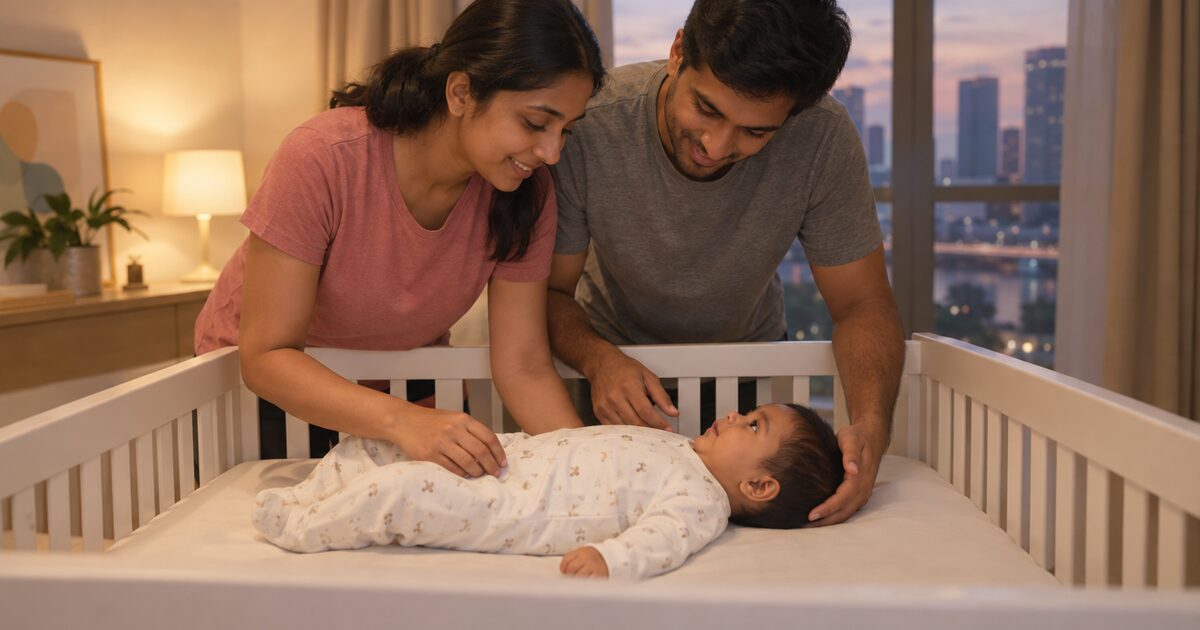
- Putting your baby down on the tummy or side: use the back for every sleep, naps included, until age one (HealthHub).
- Sharing your bed, or letting your baby sleep on a sofa: use a cot in your room with a firm mattress and nothing loose in it (HealthHub).
- Over-wrapping for sleep: dress your baby lightly, as KKH advises, in a room that suits a lightly clothed adult.
- Shaking your baby: HealthHub says never to do it, because it can cause bleeding or swelling in the brain.
- Giving water, juice, honey or solids too early: no extra water before 6 months, no juice, no solids before 4 months and no honey before 12 months (HealthHub).
- Letting your baby fall asleep on a milk bottle: wipe the gums after feeds and move to a cup by age 1 (HealthHub).
- Waiting out a fever in a baby under 3 months: KKH treats it as an emergency, so go to a children's emergency department.
- Giving cough and cold medicine or aspirin on your own: under age 2, HSA says to ask a doctor first, and KKH rules out aspirin without one.
- Putting off vaccinations: follow the national schedule, where measles and diphtheria shots are compulsory by law (HealthHub).
- Screens or background TV before 18 months: MOH says no screen use except video calls.
- Leaving your baby alone on an adult bed, a changing table or in the bath: stay within reach, since KKH sees falls from adult beds as a common cause of head injuries in children aged 2 and under.
- Holding your baby on your lap in a car: the law requires an approved child restraint under 1.35 m, and KKH advises a rear-facing seat.
- Window grilles left open, baby walkers and sarong cradles: keep grilles locked at all times and skip the walker and sarong cradle, which HealthHub links to falls.
- Brushing off low mood that lasts beyond two weeks: SingHealth says to get professional advice, and your GP or polyclinic can start that.
Sleep: on the back, in a cot, lightly dressed
HealthHub's safe sleep tips follow the AAP. Lay your baby on the back for every sleep, naps included, until the first birthday, and stop swaddling once your baby can flip over alone.
Share a room, not a bed. HealthHub says a cot placed close to your bed is safer for at least 6 months, and preferably a year. You can bring your baby into bed for a feed or a cuddle, as long as they go back to the cot before you sleep. Give the cot a firm mattress and a fitted sheet, and keep blankets, bumpers, pillows and soft toys out of it. HealthHub rules out sofas, armchairs and nursing pillows for sleep. Our nursery set-up checklist walks through the cot and room.
Singapore is hot, and with aircon on it's easy to overcorrect. KKH says to dress your baby lightly for sleep and avoid covering the head. To check warmth, feel the tummy or neck. HealthHub notes that hands and feet can feel cold even when your baby is warm enough. A wearable blanket is safer than a loose one. KKH's fever advice adds that over-wrapping can push your baby's temperature slightly above normal.
Feeding: milk first, food at the right age
Feeding on demand isn't a mistake. HealthHub calls latching on demand, breastfeeding when your baby asks, the most recommended method. A baby feeding well at the breast or bottle needs no extra water in the first six months, it adds.
Some foods have a fixed age. HealthHub keeps honey off the menu until 12 months in any form, cakes included, because it can cause infant botulism. Plain full cream cow's milk waits until 12 months too, since it's low in iron and can damage young kidneys. Fruit juice isn't recommended for babies at all.
HealthHub says solids should start around 6 months and never before 4, as starting earlier may raise the risk of food allergies and too much weight gain. Finger foods come in at about eight months. Leave out whole nuts, grapes and hard sweets, which HealthHub lists as choking hazards. Our starting solids guide takes it month by month.
A bottle at bedtime is the other habit to break early. HealthHub links long use of the milk bottle, especially to fall asleep, to baby bottle tooth decay. Before teeth arrive, wipe the gums with a wet cloth after each bottle feed. Then brush the first tooth with a soft brush, and swap the bottle for a cup by age 1.
Health: fever, medicine, vaccines and screens
A baby under 3 months with a fever needs a doctor straight away. KKH puts "fever or illness in an infant less than 3 months old" on its Children's Emergency list. Its fever advice also says paracetamol isn't for babies under 3 months, and ibuprofen isn't for babies under 6 months. Our baby fever guide covers the older months. To get an accurate reading first, see how to take baby temperature.
HSA says children under two should see a doctor before taking any cough and cold medicine. Used wrongly, these medicines can cause a fast heartbeat or seizures in very young children. Some brands sell children's and adults' versions at different strengths, so read the label and use the spoon or cup that comes with it. KKH adds no aspirin unless a doctor says so. Our guide on how to give medicine to a baby covers measuring a dose with the syringe.
HealthHub says measles and diphtheria vaccination is compulsory under the Infectious Diseases Act. Eligible Singaporean children get the National Childhood Immunisation Schedule's listed brands fully subsidised at polyclinics and CHAS GP clinics. Some jabs bring a fever on the day and the day after. Our vaccination guide lists the dates.
MOH's guidance on screens, updated in January 2025, says no screen use under 18 months except interactive video calls, and no TV left on in the background. Our screen time guide picks up from there.
Home and car safety
Falls are the big one at home. KKH's Children's Emergency sees about 28,700 injured children a year, and more than half of those injuries come from falls. In children aged 2 and under with head injuries, almost 90 per cent happen at home and up to half in the bedroom. KKH names the adult bed as a common place to fall from, and HealthHub warns against leaving your baby alone on the changing table.
Water needs the same care. HealthHub says never to leave your baby alone in the bath, because babies can drown in as little as 5cm of water. Empty pails and the tub after use.
In a high-rise flat, window grilles come first. HealthHub says to keep them locked at all times with the keys somewhere safe, and KKH says to move chairs away from windows. HealthHub also advises against baby walkers and sarong cradles, as both raise the risk of falls. Our baby-proofing checklist goes room by room.
In the car, KKH says a car seat is the only safe way to travel, and a lap or sling never is. By law, every passenger under 1.35 m needs an approved child restraint for their height and weight. The driver faces a $150 composition fine and 3 demerit points if a child rides without one, says the Traffic Police. KKH advises a rear-facing seat for at least the first two years, never in front of an active airbag, and no swaddle under the harness. Our car seat guide has a fitting checklist.
Your own wellbeing
The CDC counts taking care of yourself among its tips for parents of babies. SingHealth says depression affects about 10 to 15% of women after childbirth. Tearful "baby blues" in the first few days are common, but if low mood lasts beyond two weeks, get professional advice. HealthHub has a postnatal depression self-check online, and our postnatal depression guide lists where to get help.
Share the nights with your partner, as HealthHub suggests, so you both get rest. If grandparents or a helper look after your baby, HealthHub says they should follow your safety instructions.
First year baby mistakes by age
| Age | Mistake to watch for | What to do instead |
|---|---|---|
| 0 to 3 months | Waiting at home with a fever; over-wrapping | See a doctor for any fever under 3 months (KKH); dress lightly (KKH) |
| 4 to 6 months | Water, juice or solids too early | No extra water or juice; solids around 6 months, never before 4 (HealthHub) |
| 7 to 9 months | Hard or round finger foods | Finger foods from about 8 months, but no whole nuts, grapes or hard sweets (HealthHub) |
| 10 to 12 months | Milk bottle to sleep; honey or plain cow's milk early | A cup by age 1; honey and full cream milk from 12 months (HealthHub) |
| Every month | Tummy sleeping; a lap in the car; screens; open grilles | Back to sleep (HealthHub); rear-facing car seat (KKH); no screens before 18 months (MOH); grilles locked at all times (HealthHub) |
When to see a doctor
Go to the Children's Emergency at KKH or NUH, or call 995, if your baby shows any of these signs from KKH's emergency list:
- Fever or any illness under 3 months of age (KKH)
- Difficulty breathing, wheezing or noisy breathing (KKH)
- Looking pale, ashen or blue (KKH)
- Poor feeding, or vomiting so often that fluids won't stay down (KKH)
- Drowsiness, irritability or crying that won't stop (KKH)
- A seizure or loss of consciousness (KKH)
- A fall from a height or a head injury (KKH)
- Swallowing or breathing in an object, or a possible poisoning (KKH)
For a cold or viral fever in a baby over 3 months who is alert and feeding, KKH says your GP or polyclinic is faster and cheaper. KKH's free U-PAL online advice service answers questions on common problems 24 hours a day.
Frequently asked questions
Which first year baby mistakes matter most?
The ones tied to safety: how your baby sleeps, shaking, and leaving your baby alone on a bed or in water. Travelling without a car seat and waiting out a fever under 3 months are on it too. A messy routine isn't.
Is co-sleeping safe in Singapore?
HealthHub advises room-sharing without bed-sharing. Your baby is safer in a cot close to your bed for at least 6 months, preferably a year. Bring your baby in for a feed or comfort, then lay them back in the cot on their back.
Is feeding on demand a mistake?
No. HealthHub calls latching on demand, breastfeeding when your baby asks, the most recommended method. Singapore's own guidance backs it.
Does my baby need a car seat in a taxi?
The law exempts taxis, but KKH says the crash risk is the same and a lap is never safe. Bring an approved car seat if you can. In your own car, an approved child restraint is the law for every child under 1.35 m.
Can my baby watch TV if it's only on in the background?
MOH says no for babies under 18 months: no screen use except interactive video calls, and no background TV.
- HealthHub (Health Promotion Board), Parent Hub: Baby sleep, 7 safe sleeping tips for baby (read 5 Nov 2026)
- HealthHub (Health Promotion Board), Parent Hub: Childhood healthy diet, 0 to 2 years (read 5 Nov 2026)
- HealthHub, Care of your newborn: to have and to hold (read 6 Nov 2026)
- HealthHub, Common childhood injuries and childhood injury prevention (read 5 Nov 2026)
- KK Women's and Children's Hospital, How to use the Children's Emergency wisely (read 5 Nov 2026)
- Health Sciences Authority, Cough and cold medicines for children: what you should know (read 5 Nov 2026)
- Ministry of Health, Guidance on screen use in children, updated January 2025 (read 5 Nov 2026)
- SingHealth and KKH Neonatology, 3 steps to car seat safety for baby's first year (read 5 Nov 2026)
Baby blocked nose: how to clear it, and which breathing sounds need a doctor
Baby blocked nose? Saline drops, then gentle suction, as KKH and NUH advise. Plus a table of noisy breathing sounds and ...
8 min read
Baby Choking First Aid: What Every Singapore Parent Should Know
Baby choking first aid in Singapore: spot true choking, do infant back blows and chest thrusts, know when to call 995, a...
11 min read
Baby colic, reflux and gripe water: what Singapore doctors advise and when to worry
Baby colic and reflux in Singapore: what KKH, NUH and HealthHub say about gripe water and gas drops, how to soothe cryin...
12 min read